An A instead of a B is worth about 5% of revenue
The FDA found handwashing non-compliance in 73% of full-service restaurants, and improper cold holding appears in roughly 40% of inspections nationally.

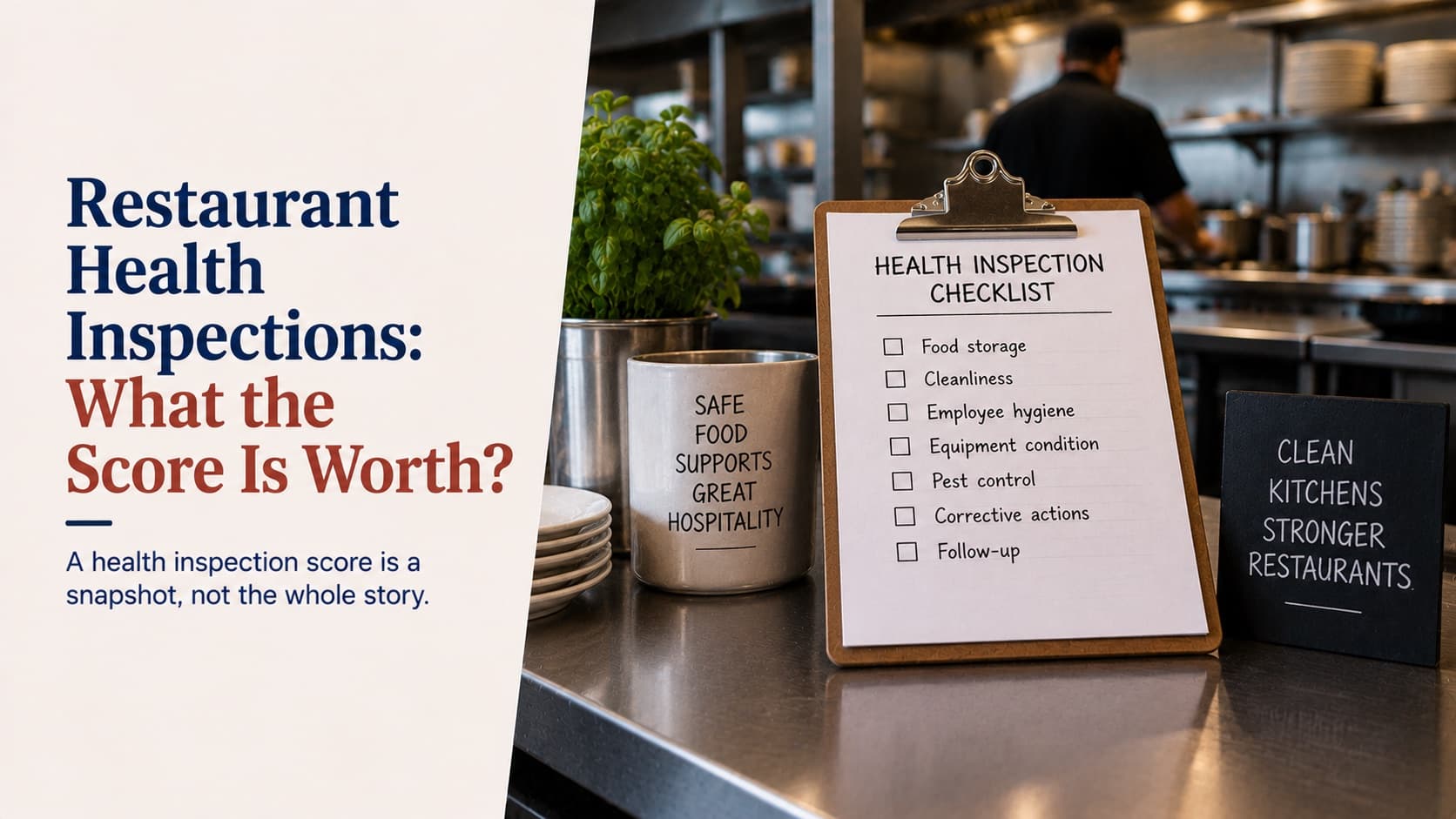
Health inspections get treated as a compliance chore — something that happens to you, that you hope goes well, and that you think about twice a year.
There is decent evidence they're a revenue line.
The grade is worth money, and it's been measured
Los Angeles County introduced hygiene grade cards in restaurant windows in 1998, which created something unusual in this industry: a natural experiment with published economics behind it.
The findings from Jin and Leslie's work on that programme:
- Inspection scores went up after grades became visible.
- Consumer demand became sensitive to hygiene quality — which it demonstrably was not when the information wasn't displayed.
- Earning an A rather than a B is associated with roughly 5% greater revenue. Related estimates put an A at up to 6%, a B at 1–2%, and a C at roughly a 1% decrease.
Five percent of revenue is not a rounding error. For most independent restaurants it exceeds net margin. And it is available for an operational improvement that costs almost nothing — the difference between an A and a B is usually a handful of repeat findings, not a capital project.
One correction, because this study gets over-cited. Jin and Leslie's early work reported a 20% reduction in foodborne illness hospitalisations attributable to grading, and that number circulates widely. Subsequent research using improved data and methods found that the 20% result does not hold up. Other estimates put the reduction around 13.1%. So: the revenue and behaviour effects are the durable findings; treat the dramatic public-health figure with caution, and don't repeat the 20% without the caveat.
The score is now a search result
The revenue mechanism has changed since 1998 in a way that makes it larger, not smaller.
In 1998 the grade card was in the window, visible to someone already standing outside. Today inspection results are public records published online almost everywhere, and they increasingly surface where people decide where to eat rather than where they arrive. That makes your score part of the same surface as your reviews and your Google Business Profile, which is a discovery asset rather than a compliance artifact.
It also means your record is durable and readable — by guests, and by anyone evaluating your building, which is exactly the research I recommended when choosing an address.
Two clusters produce most of the findings
The good news for anyone trying to move from a B to an A: the violations that matter concentrate heavily.
Temperature control. Improper cold holding is cited in roughly 40% of all restaurant inspections nationally — the single most common finding. The specific failures are food not held at 41°F or below, and failure to date-mark refrigerated ready-to-eat foods after 24 hours.
Handwashing and bare-hand contact. The FDA found failures to comply with handwashing guidelines in 73% of full-service restaurants. Bare hand contact with ready-to-eat food is among the most visible and most cited critical findings.
Both clusters sit inside what the Food Code treats as priority items — formerly "critical violations" — the ones that contribute directly to foodborne illness: improper cooking temperatures, unsafe holding temperatures, cross-contamination, and lack of handwashing. The Food Code's named major risk factors are food from unsafe sources, inadequate cooking, improper hot and cold holding, poor personal hygiene including handwashing, and contaminated equipment.
Notice what's not on that list: the cosmetic things operators panic about before an inspection. Scuffed floors and a cluttered dry store are findings, but they aren't the ones that move a grade or hurt a guest.
What that implies for how you prepare
If 40% of inspections cite cold holding and 73% of full-service restaurants fail handwashing compliance, then a targeted drill on two things beats a general clean-up:
Make cold holding continuously measurable rather than periodically checked. Logged temperatures at fixed intervals, with a named owner per shift and an escalation when a unit drifts. The failure mode isn't usually a broken cooler — it's a cooler that drifted for six hours overnight and nobody looked.
Date-mark everything ready-to-eat, without exception. It's a mechanical rule, it's cited constantly, and it is entirely within your control.
Make handwashing observable. Sinks accessible and unblocked, stocked at all times, and a habit that survives the rush — which is when it stops, because that's when it costs seconds. A 73% non-compliance rate in full-service restaurants is not a knowledge problem. Everyone knows. It's a design and supervision problem.
Eliminate bare-hand contact with ready-to-eat food as a standing rule rather than a preference, because it's among the easiest findings for an inspector to observe directly.
The allergen controls I wrote about in the allergen post share the same character: procedural, cheap, and dependent on whether the closing manager actually does them at 11pm.
Two things worth knowing about the process
There is no courtesy inspection. I wrote about this in the context of opening, where a health district stated it plainly: inspectors do not conduct courtesy inspections. Nobody is going to walk your kitchen and tell you what would fail. You find out during the real one.
Your record is cumulative and public. A single bad inspection is survivable. What reads badly to anyone examining you later — a buyer, a landlord, a lender — is the same violation repeating across inspections, because that indicates a system that doesn't correct rather than a bad day.
What I'm not going to give you
A list of "the top 10 violations" ranked nationally. Scoring systems differ by jurisdiction — letter grades, numeric scores, pass/fail — and so does what gets recorded. The two clusters above are well supported; a precise national ranking is not.
A pre-inspection checklist. Your jurisdiction publishes its own inspection form. Use that one. Any checklist I wrote would be a generic approximation of a document you can download for free.
The 20% illness reduction figure, as above. It's been challenged and I'd rather leave it out than repeat it because it's compelling.
The short version
Treat the grade as a revenue number, because it's been measured as one: roughly 5% between an A and a B. Focus preparation on the two clusters that generate most findings — cold holding with date-marking, and handwashing with no bare-hand contact — rather than on appearance. And assume no one will warn you first.
Disclosure: I work at Katalyst. Temperature logging integrates with restaurant systems including ours, so treat that recommendation with the usual suspicion — a paper log and a named owner per shift produces most of the benefit. The part I'd actually stand behind commercially is narrower: the revenue effect above is a reason to treat inspection prep as a marketing investment, and that reframing costs nothing.
See how Katalyst handles your service style
A 30-minute walkthrough of the platform, tuned to how your restaurant actually runs.