White-label delivery hands you every refund and complaint
DoorDash Drive's $9.75 flat fee beats a 25% marketplace commission only on orders above $44 once card processing is counted. Against the 15% tier, above $81.

In June I made the case for taking delivery orders on your own site instead of renting the customer from a marketplace at 25–30%. The obvious follow-up question is who drives the food, and for most restaurants the answer is a white-label courier: DoorDash Drive or Uber Direct. You take the order, they send a driver, you pay a flat fee per delivery instead of a percentage.
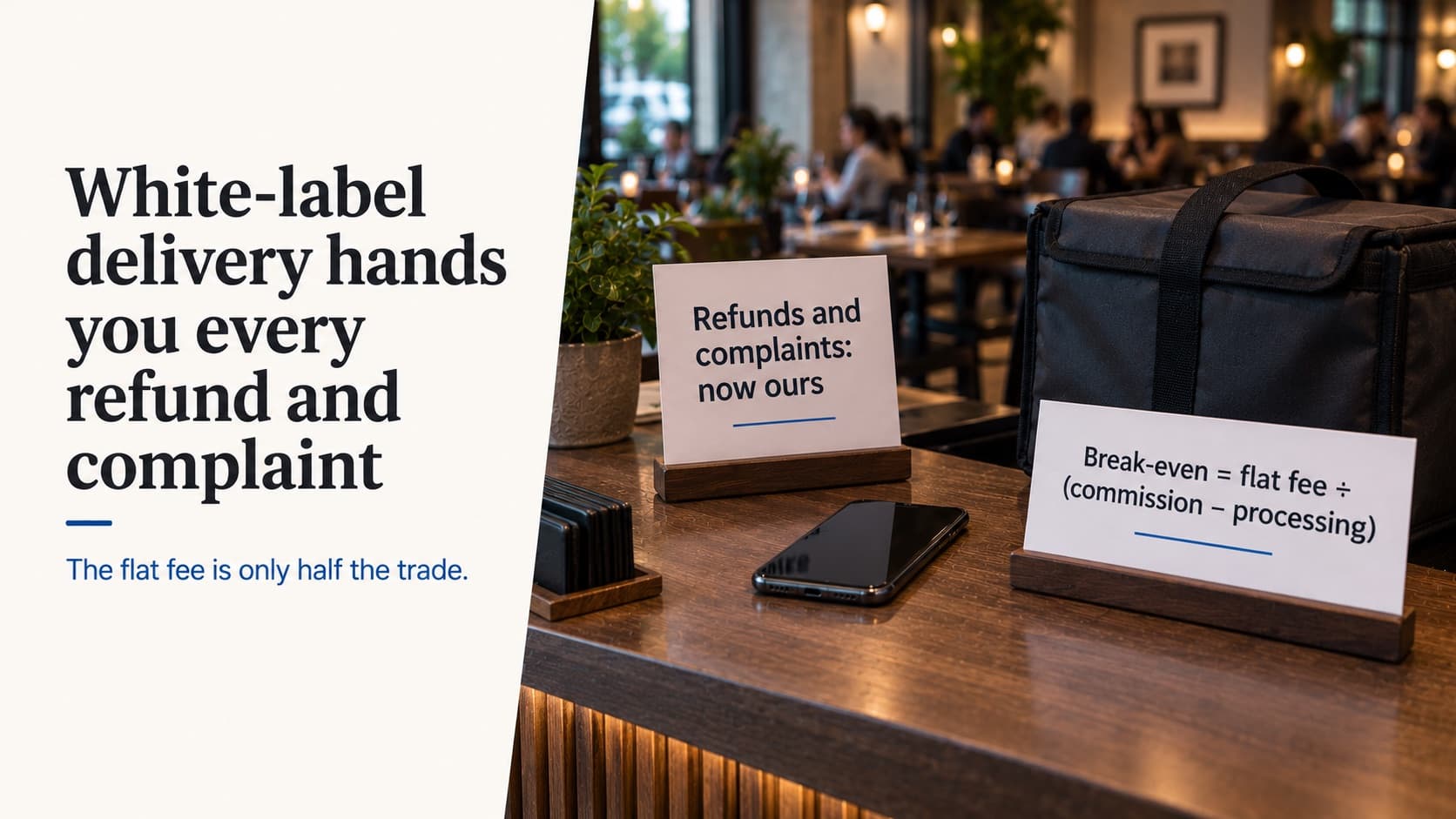
That trade is usually described as "flat fee instead of commission," full stop. It's two trades, and the second one is in the terms of service: the platform stops being the party the customer complains to. Both matter, and the second is the one nobody prices.
What the flat fee actually is
DoorDash Drive On-Demand. $9.75 for a delivery within 5 miles, plus $0.75 for each mile beyond that, up to a 15-mile maximum — so the most a single delivery costs is $17.25. DoorDash takes $2.75 off the base rate if you let the customer tip and pass 100% of that tip to DoorDash for the driver, which brings a short delivery to $7.00. No signup, subscription or termination fees.
Uber Direct. Uber's merchant page says pricing "starts at $7.99 per delivery" and varies by order type, distance, speed and market. The only complete rate card Uber has published is the one attached to its Shopify channel, and it's instructive:
| Routed miles | Price |
|---|---|
| 0–5 | $10.00 |
| 5–8 | $12.00 |
| 8–11 | $14.00 |
| 11–14 | $16.00 |
| 14–20 | $18.50–$20.00 |
On top of that card: +$3 per delivery in California, +$5 in New York City, +$10 in Seattle. Your own channel may be priced differently. Ask for the rate card for your address in writing, because "from $7.99" is the floor, not the quote.
The break-even, with processing counted
A flat fee beats a percentage once the order is big enough. The honest version of the formula subtracts the card processing you pay on your own channel, because the marketplace was covering that inside its commission:
break-even order = flat fee ÷ (commission − processing)
At roughly 3% processing:
| Your marketplace tier | vs Drive at $9.75 | vs Drive at $7.00 (tip passed through) |
|---|---|---|
| 15% (DoorDash Basic) | $81 | $58 |
| 25% (DoorDash Plus) | $44 | $32 |
| 30% (DoorDash Premier) | $36 | $26 |
Against Uber Eats, which moved its entry tier to 20% in March 2026, Uber Direct's $10 short-distance price from the published card breaks even at $59 against Lite, $45 against Plus and $37 against Premium.
Read the first row twice. If most of your delivery orders sit on DoorDash's 15% tier, a white-label courier at the full $9.75 costs you more on every order under $81 — which for most restaurants is most orders. The savings live on the 25% and 30% tiers, and they grow with ticket size. A $30 family order barely moves; a $90 catering tray saves $20 or more.
The table also flatters dispatch in one way. It compares the same order on two channels, and assumes the order shows up either way. The marketplace is also selling you discovery. A first-time customer who found you on the app isn't going to find your website instead. White-label delivery is a margin tool for demand you already own — regulars, direct traffic, catering accounts — not a replacement for the app's reach.
What moves to you with the order
This is the part the pricing pages don't lead with.
Customer support is yours. Uber Direct's API terms are blunt: "Merchant will be responsible for all support to Designated Recipients, including resolving any disputes or concerns." DoorDash's Drive terms put complaints about "the nature, quality, content, number, or packaging" of the food on the merchant. On the marketplace, a customer with a cold order opens the app and gets a refund you may never hear about; on white-label, they call your host stand.
Refunds are yours too, with a narrow exception. DoorDash reimburses some or all of the delivery cost when a delivery runs more than 45 minutes late and DoorDash is at fault. It doesn't have to match a refund you choose to give the customer for the food.
Cancellations cost money. A DoorDash Drive delivery can't be cancelled through the API once a driver is assigned, and the fee on an order cancelled after dispatch is non-refundable. If a customer's payment fails and you don't cancel in time, the driver is still sent and you still pay. Uber Direct charges $5 if you cancel after a courier accepts, the full delivery charge if you cancel after pickup, and the full charge again as a return fee when nobody's home.
Tips go through you. Both platforms expect you to collect the tip on your channel and remit it for the driver. That's the price of Drive's $2.75 discount, and it's also a reconciliation line your bookkeeping needs to handle — tips collected, tips remitted, zero retained.
Insurance. Uber's API terms require merchants to carry at least $1 million per occurrence in commercial general liability. Most restaurants already do; check yours before you sign rather than after the first incident.
None of this is a reason to avoid white-label delivery. It's a reason to price in the minutes. If your team handles twenty delivery complaints a week that the marketplace used to absorb, that's labor, and it goes on the same side of the ledger as the courier fee. The handoff between kitchen and driver is where most of those complaints start, and it matters more once they're yours to answer.
Where the flat fee loses
- Small tickets on a 15% plan. Covered above. Below the break-even, the marketplace is cheaper per order before you count anything else.
- Long runs. Drive stops at 15 miles and charges per mile beyond 5; Uber's card steps up every three miles. A suburban restaurant with a wide delivery zone should price its outer ring separately.
- Low volume. The marketplace does your customer service at scale. A restaurant sending four direct deliveries a day won't notice the support load; one sending sixty will.
What I'm not going to give you
Your Uber Direct price. Uber publishes a floor and one channel's rate card, and says rates vary by market. Anything I quoted for your city would be a guess.
A ruling on whether delivery fee caps apply. New York City's caps bind a "third-party food delivery service," defined around the platform that sells the food. Nothing I found settles whether a dispatch-only courier you book for your own order counts. Don't plan around a cap that may not reach you.
A total savings figure. It depends on your tier, your ticket size and how many of your orders you'd get without the app. The table above is the tool; your order history is the input.
What to do
- Pull 90 days of marketplace orders and sort them by ticket size. Count how many sit above the break-even for your tier.
- Get the courier rate card for your address from both platforms, including city surcharges and the per-mile steps.
- Decide who answers the phone when a white-label order goes wrong, and what they're authorized to refund. Write it down before launch.
- Set a delivery minimum or a delivery fee on your own site that keeps small orders from running below break-even. The customer sees one fee; you see the courier bill.
- Keep the marketplace for discovery and move your regulars. Most restaurants that do this well run both.
Disclosure: I work at Katalyst, and our online ordering books Uber Direct and DoorDash Drive couriers per order, so I have an interest in restaurants taking delivery in-house. That's why the first row of the break-even table is in here. On DoorDash's 15% tier, white-label delivery loses money on most orders, and I'd rather you learned that from the arithmetic than from your first month's courier bill.
Related Katalyst products
See how Katalyst handles your service style
A 30-minute walkthrough of the platform, tuned to how your restaurant actually runs.