Your projections can't carry an SBA acquisition loan
From 1 October, SOP 50 10 8.1 lifts acquisition coverage to 1.25x on historical earnings alone. Startups keep projections and pay in collateral instead.

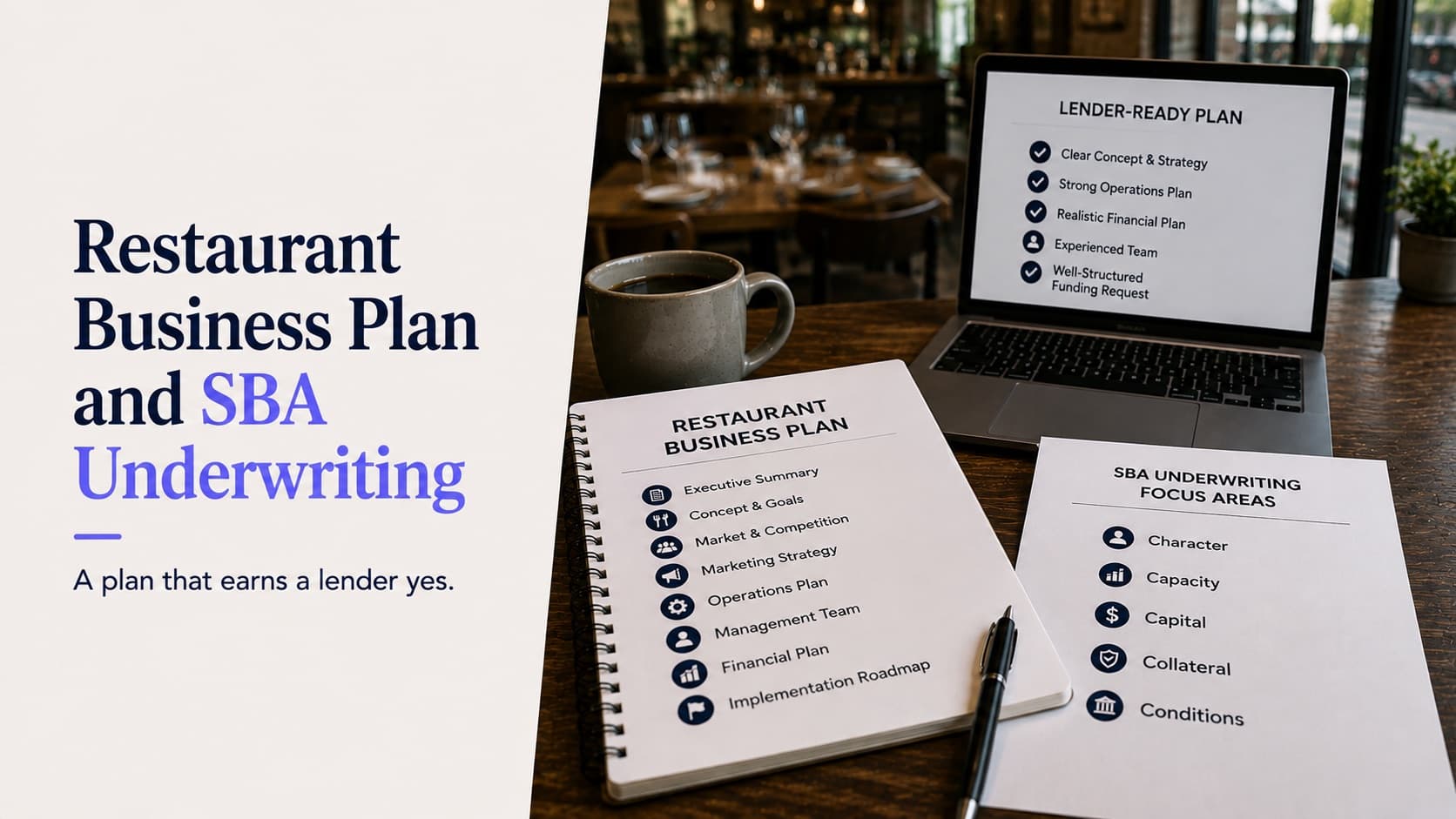
Search "restaurant business plan" and you get templates. Executive summary, market analysis, competitive landscape, marketing strategy, management team, and a three-year financial projection with a hockey stick in year two.
Build that document and you have a document. What you may not have is a loan, because the part of it lenders are permitted to rely on just got smaller — and for one very common transaction, the projections stop counting entirely in a few weeks.
The rule change worth knowing before October
SBA's SOP 50 10 8.1 takes effect 1 October 2026, applying to applications issued an SBA loan number on or after that date. Anything that gets its number through 30 September runs under the current SOP 50 10 8.0.
Two changes matter for restaurants:
Coverage rises from 1.15x to 1.25x for Initial Acquisitions and owner buyouts. The business's earnings must cover all post-closing debt service by at least a quarter again.
And the coverage must be met on historical or adjusted earnings — the lender may not rely on post-closing projections to satisfy it.
That second one is the structural change, and it inverts the standard advice. If you're buying an existing restaurant, the beautiful model showing how your concept lifts revenue 20% in year one is not underwriting material. It can support the story. It cannot carry the coverage test. What carries the coverage test is what the restaurant actually earned, adjusted.
Which means the seller's books are your loan application. I went through how to verify those in the buying-and-selling post, and the reconciliation exercise there is now doing double duty: it determines your price and whether the deal finances at all.
One more from the same SOP: any Initial Acquisition or Business Expansion with a purchase price of $3 million or more now requires a Quality of Earnings report. Most independent restaurant deals sit well below that, but multi-unit purchases can cross it.
The two paths underwrite completely differently
This is the distinction the business-plan genre flattens, and it changes what you should spend your effort on.
| Buying an existing restaurant | Building from scratch | |
|---|---|---|
| Coverage tested on | Historical / adjusted earnings | Projections — there's nothing else |
| Projections | Supporting, not qualifying (from 1 Oct) | Load-bearing |
| What decides it | The seller's provable numbers | Your injection, collateral and guarantees |
If you're buying, your job is documentary: make the historical earnings provable and the add-backs defensible. If you're building, projections are all anyone has — and because they're weak evidence, the lender compensates by taking more security from you personally. Which brings us to the part nobody puts in a business plan template.
What you are actually pledging
Equity injection: 10% minimum. Under SOP 50 10 8, startups and complete changes of ownership require a minimum injection of 10% of total project costs. Note "total project costs," not the loan amount — and note that the SBA treats a business as a start-up if it has been generating revenue for one year or less, so a restaurant that opened ten months ago is still a startup for this purpose.
A personal guarantee at 20% ownership. Anyone holding 20% or more must guarantee. The aggregation rule catches people off guard: combined ownership between spouses and minor children counts, so two spouses at 15% each are over the line, and each guarantees the loan in full — not 15% of it, not half of it.
Your house, if it has equity. Lenders will generally take residential or investment property as collateral where available equity exceeds 25% of the property value. Many banks, particularly larger ones, simply won't lend to a restaurant borrower who has no real property to pledge.
Life insurance, collaterally assigned. Where the business depends on one or two people — which is every independent restaurant — lenders are required to obtain life insurance with a collateral assignment filed with the carrier, typically for the full loan amount. It can be reduced or waived where there's substantial collateral or a real succession plan, but plan for it. It's also a real underwriting timeline item, because you have to be insurable, and that takes weeks.
Add those together and the honest summary is: the SBA loan is not cheaper capital because the risk went away. It's cheaper capital because the risk moved onto your balance sheet, your home, and your life. That's frequently a good trade. It is not the trade the "financing options" articles describe. The other instruments — and particularly the one to avoid — are in the financing post.
The lease clause that decides your loan
Restaurants get declined for reasons that have nothing to do with the plan document, and the most avoidable is lease term.
Common decline drivers for restaurant borrowers: credit that can't be repaired quickly, weak or declining financials, and short-term or unfavorable leases. That last one is structural — a lender financing a ten-year note wants site control for the term, including options, and a restaurant with three years left and no renewal cannot support the loan regardless of how it performs.
The fix is sequencing, not persuasion: renew or extend before you apply. If you're buying, make lease extension a condition you negotiate alongside price rather than a thing you discover in underwriting. Assignment also requires landlord consent, which is the landlord's moment of maximum leverage — the mechanics are in the lease negotiation post.
What the plan document is actually for
None of this means skip the plan. It means understand its job, which is not to prove the numbers.
It proves you understand the operation. A lender reading a restaurant plan is looking for evidence you know what prime cost is, what your labor model is at different volumes, and what happens in month four. The genre's weakest sections — "market analysis," a paragraph on trends — do none of that.
It makes the assumptions auditable. A projection is only worth something if each line traces to a stated assumption: covers per daypart, average check, food cost by category, labor hours by station. Give the reader the assumptions and the model becomes checkable. Present a revenue line with no derivation and the reader has to take it on faith, which is precisely what the new SOP tells them not to do.
It shows the break-even month and the runway to it. This is the number I'd lead with, and most plans bury it. The most common way first-time restaurants die isn't bad food — it's running out of cash before the ramp finishes, which is why working capital belongs in the ask rather than in the hope.
If you want the underlying cost brackets to build from, they're in the cost-to-open post.
What I'm not going to give you
An approval rate for restaurant SBA loans. Figures circulate; I couldn't trace them to a published SBA dataset broken out by industry and loan type in a way I'd stand behind. Banks do treat restaurants as higher risk, which is well documented and unsurprising. The specific percentage is not something I can source.
A template. Templates produce the document everyone else submits. The lender has read a hundred of them.
A promise that a strong plan overcomes weak collateral. From what I can see in the underwriting rules, it doesn't. The plan explains; the injection, the coverage and the security decide.
What to do, in order
If you're buying and can get a loan number before 30 September, understand that you're underwriting to 1.15x rather than 1.25x, and that projections can still contribute. That is a materially easier test, and it expires. Talk to your lender about their submission timeline this week, not next month.
If you're buying after that, build the file backwards from the seller's historical earnings. Reconcile POS, merchant statements, bank deposits and sales tax returns before you agree on a price, because the adjusted earnings figure that survives that reconciliation is the number the loan is sized against.
If you're building from scratch, stop polishing the projections and start assembling the security package: the injection in a seasoned account with a documented source, the collateral schedule, an insurability check, and a lease with enough term to cover the note.
Either way, get the lease term fixed before you apply. It is the cheapest decline to prevent and the hardest to fix once you're in process.
Disclosure: I work at Katalyst, and clean POS reporting is something we sell — which is directly self-serving to point out in a post about historical earnings becoming the only acceptable evidence. So weigh it. But note the direction the rule moved: from 1 October, for the most common restaurant transaction, a lender is told to look at what the business did and not at what you say it will do. Whatever system you run, that is an argument for keeping records you could hand to a stranger.
Topics
See how Katalyst handles your service style
A 30-minute walkthrough of the platform, tuned to how your restaurant actually runs.