15 questions to ask in every POS demo (and the answers that should worry you)
A POS demo is the vendor's home turf. These 15 questions — on pricing, contracts, offline behavior, and exit terms — take it off script.


A POS demo is a performance. The rep has given it two hundred times, every click lands, every screen loads instantly on a menu that was built to demo well. None of that tells you what the system — or the company behind it — will be like to live with for the next three years.
I sat through more than twenty of these as an operator, across two renewal cycles and one full migration. The useful information never came from the scripted part. It came from the questions that forced the rep to either produce a number in writing or visibly start improvising. That second category is the point of this list.
Take these 15 into every demo. Ask them in order or out of order, but ask all of them, and write the answers down — you'll want them side-by-side when you're comparing vendors later against a full buyer's framework.
Pricing questions
1. "What will my all-in monthly cost be — every line item?"
Not the starting price. The all-in number: base software, each required module, per-terminal fees, online ordering, loyalty, gift cards, reporting tiers, support tiers, payment-gateway fees.
The answer that should worry you: a monthly figure that names only the base plan, with everything else "depending on your needs." Vendors quote low and configure high. I've published what every major vendor actually costs in 2026 — if the demo number is far below those ranges, something required is missing from it.
2. "Is your processing priced interchange-plus, and will you put the markup in writing?"
Payment processing is usually a bigger line than the software itself. A bundled flat rate ("2.99% + 15¢ on everything") hides the markup; interchange-plus pricing publishes it.
The answer that should worry you: "our rate is competitive" with no written basis-point markup, or any suggestion that the rate is "custom" and can't be stated until after you sign.
3. "Can I use a third-party processor, and what exactly happens if I do?"
Some platforms allow it freely, some charge a monthly non-integrated-payments fee, some disable features, and some prohibit it outright. All four answers exist in the market today.
The answer that should worry you: "you can, but…" followed by a feature list you'd lose. That's processor lock-in wearing a polite costume, and it removes your only repricing leverage for the life of the contract.
4. "What did your existing customers' prices do over the last three years?"
Intro pricing is marketing; renewal pricing is the business model. Ask for the vendor's actual history of raising rates on existing customers — SaaS fees and processing both.
The answer that should worry you: the rep doesn't know, or the contract reserves the right to raise prices mid-term with 30 days' notice. That clause plus an early-termination fee means you can be repriced and charged to leave.
Contract questions
5. "What's the initial term, and what does it cost to leave early?"
Get the term length, the early-termination math, and whether termination fees stack across add-on schedules (POS, online ordering, loyalty can each carry their own).
The answer that should worry you: 36 months with liquidated damages equal to the full remaining term. I've written a separate breakdown of the contract clauses that matter most — bring it to the contract review.
6. "Do I own the hardware?"
Purchase means you own an asset. Lease means the vendor owns a hook: end-of-lease buyouts, return-condition clauses, and hardware terms that quietly outlive the software term.
The answer that should worry you: "the hardware is free." Hardware is never free — it's amortized into your processing rate or your lease, usually at a worse multiple than buying it outright.
7. "When I leave, what data do I get, in what format, and at what cost?"
Menu, customers, sales history, loyalty balances. You will leave this vendor eventually — the only question is whether your data leaves with you.
The answer that should worry you: a "data export service" with an unpublished fee, or a 30-day post-termination window. That's your own sales history being held for ransom at the exact moment you have zero leverage.
Operations questions
8. "Walk me through what happens when the internet goes down on a Friday night."
Not "do you have offline mode" — walk me through it. Can I keep taking orders? Do tickets still print? Can I take cards, and who eats the risk if a stored card later declines?
The answer that should worry you: vagueness. Offline behavior differs enormously between platforms, and the details decide whether an outage costs you twenty minutes or a full service. I covered exactly what fails, system by system earlier this week.
9. "Show me a real menu change — right now, on this screen."
Ask the rep to add an item, attach a modifier group, change a price, and push it to a terminal and the kitchen, live. Menu maintenance is the task your managers will do weekly forever.
The answer that should worry you: "menu changes are handled by our support team." That sentence means every 86'd item and price update routes through a ticket queue.
10. "Which of the features you just showed me are extra-cost modules?"
Demos blend the whole product family into one seamless story. The loyalty screen, the kiosk, the fancy dashboard — some of those are separate SKUs with separate fees and, sometimes, separate contracts.
The answer that should worry you: more than a third of what you were shown turns out to be add-ons. Re-ask question 1 with the real module list.
11. "What do your integrations actually cost — per month and per install?"
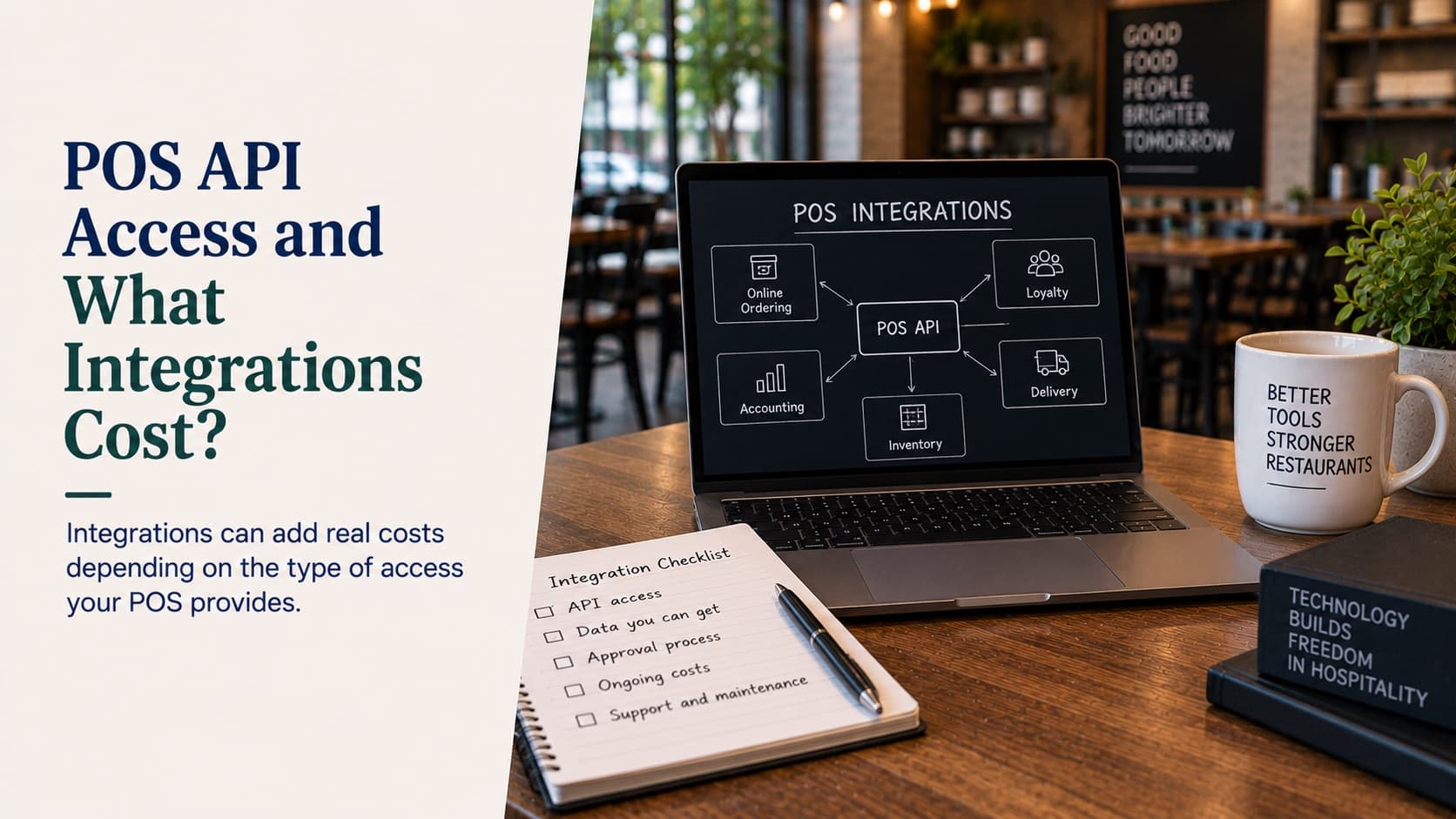
Accounting, payroll, scheduling, reservations, delivery aggregators. Integration exists is different from integration included: many platforms charge monthly per connection, and some charge the integration partner, who passes it back to you.
The answer that should worry you: "we have an open API" as the answer to a pricing question. The API being open says nothing about what the connection costs.
Support and exit questions
12. "Who answers the phone at 11pm on a Saturday, and where are they?"
POS failures happen during service, not business hours. Get specific: 24/7 by phone or chat-only after hours? In-house team or outsourced? Average hold time during weekend peaks?
The answer that should worry you: "most issues can be resolved through our help center." That's a documented self-service strategy priced as support.
13. "What's your uptime commitment, in the contract, with credits?"
Anyone can say "99.9%" in a demo. The question is whether the number appears in the agreement with service credits attached when it's missed.
The answer that should worry you: "commercially reasonable efforts" — contract language for no commitment at all.
14. "Who handles my menu build and onboarding, and what does go-live week look like?"
Implementation quality decides your first ninety days. Is the menu build done by the vendor or by you with a template? Is training on-site, remote, or a video library? Is there a named person on go-live day?
The answer that should worry you: an onboarding "package" priced per hour with no defined scope — that's how a $0 implementation becomes a $4,000 one.
15. "Give me three references running my concept, my size, for two-plus years."
Not logos. Phone numbers. Two-plus years matters because year one is the honeymoon — renewal pricing, support decay, and platform changes show up later. Concept match matters because a system that's excellent for quick-serve can be mediocre for a full-service dining room.
The answer that should worry you: references that are all brand-new customers, or "we'll need to check with marketing." A vendor with thousands of customers who can't produce three relevant ones is telling you something.
How to actually run this
Three process rules that made these questions work for me:
- Send the list ahead of the demo. Serious vendors come back with written answers; the rest come back with a longer demo.
- Write every answer down, with names and dates. When the contract arrives, diff it against what the rep said. The gaps are your negotiation agenda.
- Never sign inside the discount window. "This pricing expires Friday" is the oldest close in the category. A discount that can't survive two weeks of contract review isn't a discount — it's a deadline designed to keep you from reading.
Disclosure, as always: I work at Katalyst. I won't tell you our demo answers all fifteen perfectly — I'll tell you the standard agreement publishes the pricing, the interchange-plus markup, the data-export terms, and the uptime credits, so most of these questions are answered on paper before the demo starts. That's the bar I'd hold every vendor to, including us. If you want to test it, bring this list to our demo — we keep score in writing.
Related Katalyst products
Topics
See how Katalyst handles your service style
A 30-minute walkthrough of the platform, tuned to how your restaurant actually runs.