$400 a month: Lightspeed's price for an outside processor
Before comparing rates, find out whether you're allowed to shop them. Toast and Square are payment facilitators; SpotOn and Clover permit outside processors.

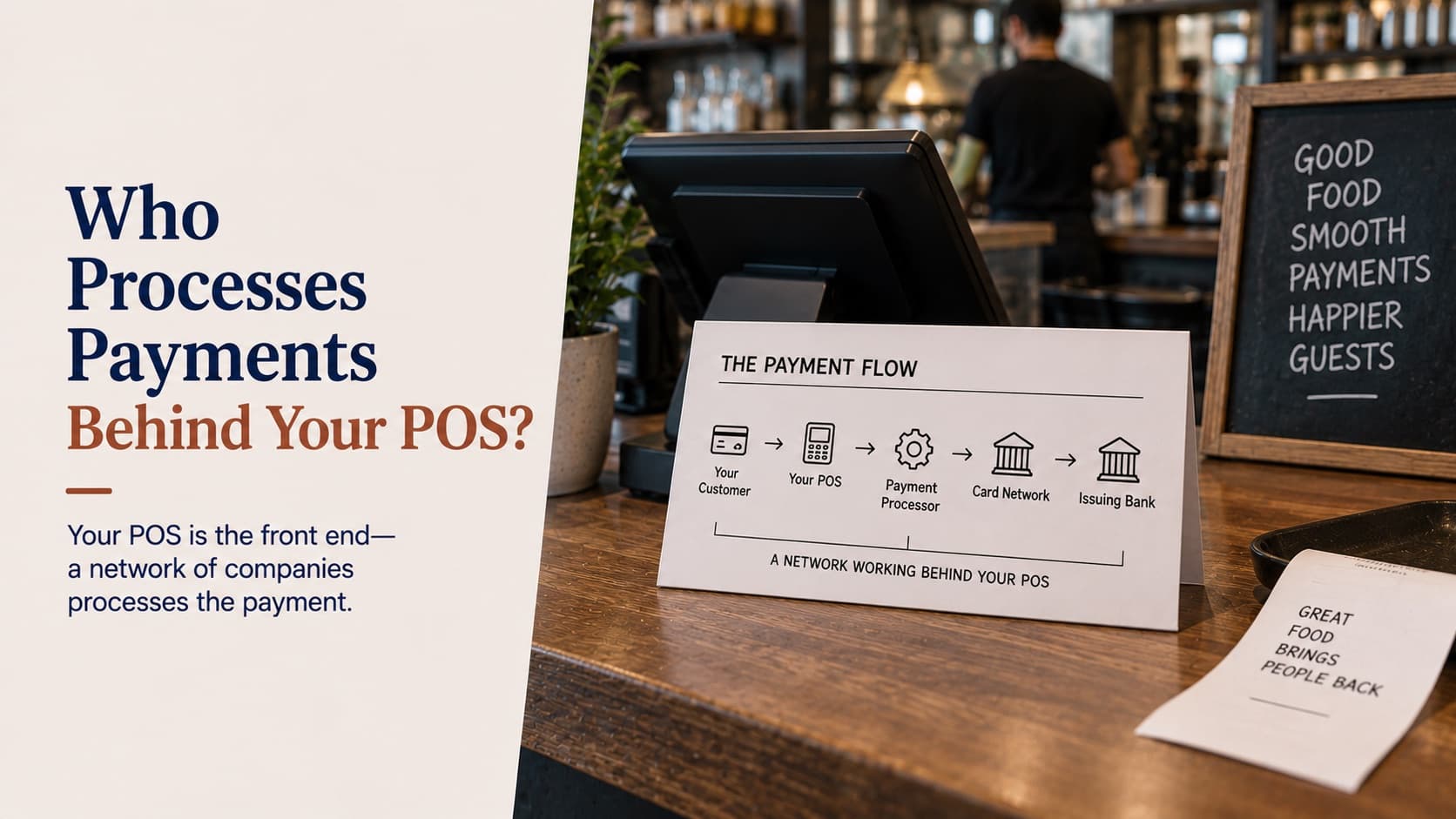
Every POS comparison eventually reaches a table of processing rates: 2.6% + 15¢ here, 2.49% + 15¢ there, "custom" somewhere else.
That table answers the wrong question. Before you can compare rates you have to know whether you're permitted to compare them — because for several of the largest restaurant POS systems, the rate isn't a negotiation. It's a published price for a service you are contractually required to buy from them.
That permission question determines far more of your lifetime cost than the opening rate does, and it's rarely on anyone's comparison chart.
Three models, not two
The industry talks about this as "integrated payments" versus "bring your own processor." There are actually three positions, and the middle one is where the surprises live.
Locked — the payment facilitator model. The POS company is the payment facilitator. You process through them, under their rules and their rate card, or you don't use the product. Toast and Square both work this way; with Toast in particular there is no option to bring your own processor.
Permitted but penalised. You may connect an outside processor, and the vendor charges you for the privilege. Lightspeed is the clearest published example: using a third-party processor can attract fees reported at up to $400 per month. Lightspeed also requires payment terminals to be purchased from Lightspeed — third-party terminals aren't supported — so even the hardware path is closed.
$400 a month is $4,800 a year. For that penalty to be worth paying, your interchange-plus savings have to exceed it, which for a small independent they frequently won't. So the fee is not really a fee. It's a rate floor enforced by contract.
Open. The system supports outside processing without a punitive charge. SpotOn permits third-party processing. Clover is architecturally processor-agnostic — it's a Fiserv product, but the platform supports a range of acquirers, which is why Clover merchants can shop interchange-plus in a way Toast merchants cannot.
The Clover caveat matters, though: which processor you actually get depends on who sold you the device. Clover units resold through a bank or an ISO commonly arrive bound to that reseller's processing, and unwinding that is a contract question, not a settings question. "Clover is open" is true of the platform and not necessarily true of the deal in front of you.
Where the vendors sit
| POS | Processing model | Can you use an outside processor? |
|---|---|---|
| Toast | Payment facilitator | No |
| Square | Payment facilitator | No |
| Lightspeed | In-house (Lightspeed Payments) | Yes, with fees reported up to $400/mo; terminals must be Lightspeed's |
| TouchBistro | In-house | Effectively no — locked to their processor |
| Clover | Fiserv platform, processor-agnostic | Yes in principle; depends on who sold you the device |
| SpotOn | In-house, but open | Yes |
| Aloha / NCR Voyix | Acquiring via Worldpay under a processing agreement announced in 2025 | Through the partner relationship |
Two things to notice.
"Integrated payments" describes at least four different commercial relationships. A payfac, an in-house processor with a penalty for leaving, a platform that resells someone else's acquiring, and an open system all get marketed with the same phrase.
The company processing your money may not be the company selling you software. NCR Voyix's Aloha runs acquiring through Worldpay under an agreement covering Aloha and the rest of its portfolio. That's not hidden, but it's not on the sales deck either, and it matters when something goes wrong: your software vendor and your acquirer are different companies with different support paths and different incentives.
Why "negotiable" is the whole ballgame
If you can shop your processing, you can buy interchange-plus: interchange passes through at cost, and the processor's markup is stated separately and explicitly. If you can't, you're on a bundled or flat rate, where the markup is buried inside a single number you can't decompose.
The difference compounds with volume, and it compounds silently, because bundled pricing hides tier downgrades — transactions that cost the processor more get repriced into a more expensive bucket without your rate ever changing on paper. I went through the mechanics of both in the bundled versus interchange-plus post, and how to read what you're actually being charged in the merchant statement guide.
At low volume, flat-rate payfac pricing is often genuinely the better deal — it's simple, predictable, and the markup on small volume is small in absolute terms. The crossover comes with growth, and that's exactly when a locked system means you can't act on it. You sign the processing arrangement when it suits you and discover it when it doesn't.
The four questions to ask any vendor
Ask these before rates, and ask for the answers in writing, because sales conversations are not contract terms:
- Are you the payment facilitator or merchant of record, or is there a separate acquirer? If separate — who?
- May I use an outside processor, and what does that cost? The answer "you can, but..." is the one to write down verbatim.
- Is my hardware usable with another processor, and can terminals be re-pointed if I change? Encryption keys are injected into terminals, and a terminal keyed to one processor is not trivially moved.
- What is the rate structure — interchange-plus or bundled? And if bundled, what happens to a transaction that doesn't qualify for the headline tier?
The per-vendor detail on each of these lives in our POS comparison pages — this post is the dimension across all of them, which is the view no vendor publishes about itself.
What I couldn't verify, and how to treat this table
I want to be explicit about the limits, because this is a competitive comparison published by a competitor.
Most sources here are secondary. Vendor terms are set in merchant agreements, not on websites, and the review sites and payments blogs I used are reporting rather than quoting contracts. Treat the table as a map of where to look, not as a substitute for reading your own agreement.
These terms change. Processing relationships in this industry are re-cut regularly — the Aloha–Worldpay arrangement is itself recent. A statement that was true in 2024 may not be true in your contract in 2026.
I left vendors out where I couldn't source the answer. Revel, Micros/Oracle, Brink, HungerRush and Lavu all appear on our comparison pages, and I could not find sourcing on their current processing arrangements that I'd stand behind well enough to put in a table with their names on it. Their absence here is my sourcing gap, not a judgement about them.
And Katalyst is in the same market. Our position is processor-flexible pricing on an interchange-plus basis. That is a claim, made by the company writing this post, and you should test it with question 2 above exactly as you would test Toast's or Lightspeed's. If the answer we give you isn't in writing in the agreement, it isn't an answer.
The one thing to take away
The rate on the proposal is a starting price. The clause that says whether you may ever change processors is the price for the life of the business.
Get that clause out of the agreement and read it before you compare a single percentage — alongside the other terms in the POS contract red flags post. A rate you can renegotiate at 2.7% beats a rate you can never renegotiate at 2.5%, and it isn't close once you grow.
Related Katalyst products
Topics
See how Katalyst handles your service style
A 30-minute walkthrough of the platform, tuned to how your restaurant actually runs.