Restaurant onboarding and training: the first 90 days decide your turnover
Most restaurant turnover happens before month three, for reasons onboarding controls. What the evidence says, and what a training program should look like.


Restaurant turnover gets treated as weather — a structural condition of the industry you plan around rather than something you influence. The numbers make that fatalism understandable: turnover ran 65.8% in 2024, down from 75.6% the year before but still extraordinary, and federal data puts median tenure in food preparation and serving at 2.0 years, the lowest of any service occupation (the private-sector median is 3.5). Quits in accommodation and food services run at roughly double the private-sector rate.
But the timing of those departures is the part worth acting on. Roughly 30% of employees leave within their first 90 days, and restaurant-specific estimates run higher still. That's not a labor market problem. That's an onboarding problem, and it's yours.
What early turnover actually costs
Estimates put replacing an hourly restaurant employee at $2,000 to $5,000 once you count separation admin, the vacancy (unfilled shifts, overtime coverage, managers working the line), rehiring, and training. Those figures derive from hospitality research that's now somewhat dated, so the real 2026 number is probably higher.
Run it on a real restaurant. A 40-person operation at 66% turnover replaces about 26 people a year. At $2,000–$5,000 each, that's $52,000 to $130,000 annually — money that never appears as a line on your P&L, which is exactly why it goes unmanaged. It's buried in the labor line I broke down in the labor cost guide.
The strongest evidence: almost nobody does this well
Gallup's research is the most useful data point in this whole subject: only 12% of employees strongly agree their organization does a great job of onboarding. Just 29% of new hires feel fully prepared to excel after onboarding. And employees who had an exceptional onboarding experience are 2.6 times more likely to be extremely satisfied at work.
(You'll see a widely-circulated claim that structured onboarding improves retention by 82%. I'm leaving it out — the underlying report isn't publicly retrievable and every citation traces back to a blog post. The Gallup figures are better sourced and make the same point.)
The argument doesn't need the weak stat anyway. Turnover is 65%+. Most of it lands in the first 90 days. The stated reasons people leave early are unclear expectations, feeling unsupported by management, and the job not matching what was described at the interview — all three are onboarding failures, not hiring failures. And only 12% of employers do onboarding well. That chain holds on its own.
What good onboarding looks like
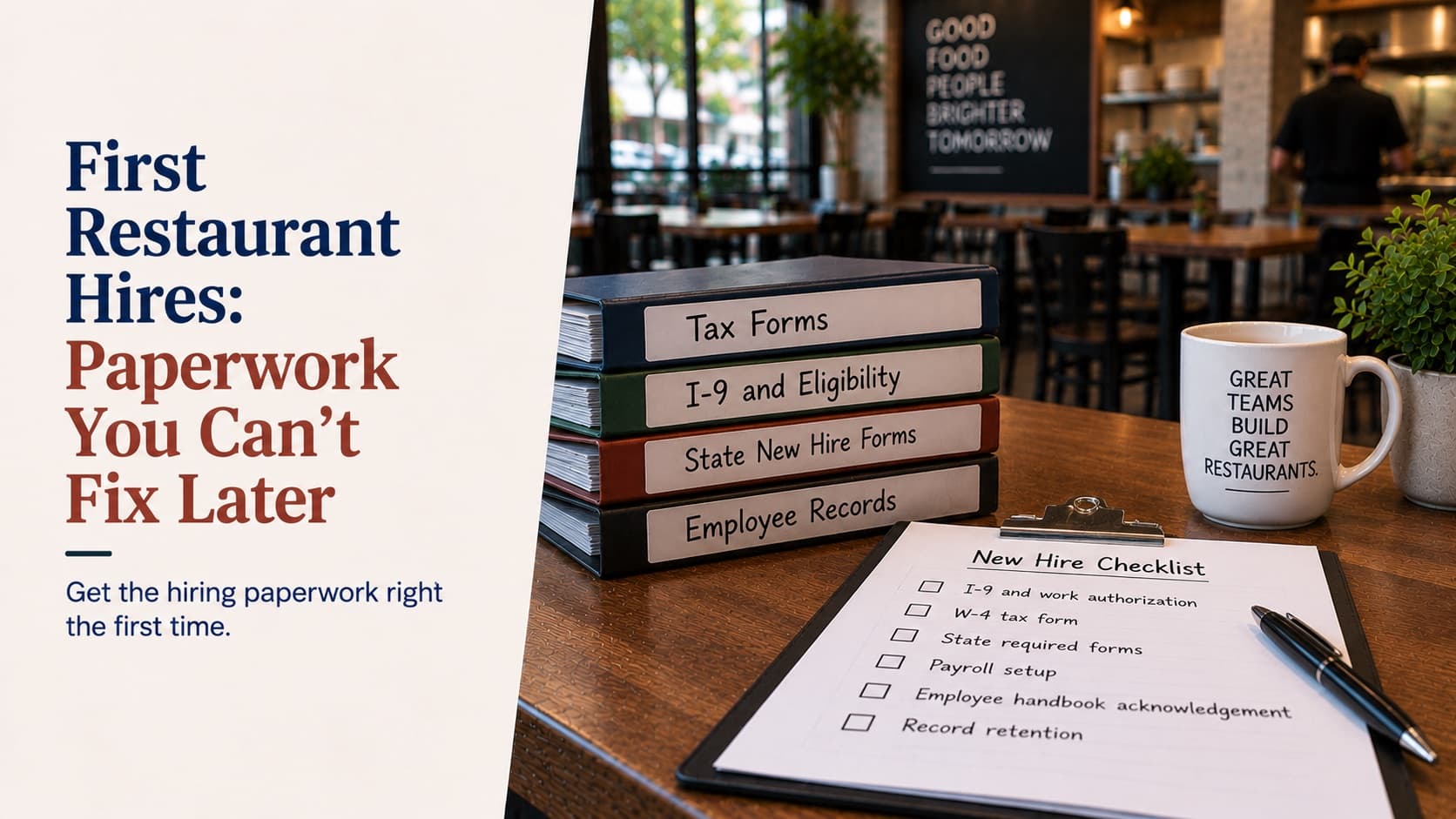
Before day one. Confirm start time, dress code, where to park, which door, and who to ask for. Get the paperwork done in advance so the first shift is spent learning the job, not filling in forms.
Day one. The manager is physically present at the start of the shift. Introductions to the whole team, a tour of both sides of the house, and an explicit statement of what "good" looks like in week one. This single conversation addresses the number-one stated reason people quit early.
Role-specific paths. Server, host, line cook, dish, bartender, and shift lead need separate documented tracks — not one generic orientation that leaves everyone to figure out their actual job by observation.
A designated trainer, not "whoever's on." Inconsistency between trainers is a documented failure mode: the new hire gets three different versions of the same task and concludes nobody knows the standard.
A competency checklist with a real gate. Sign-off per station, and an explicit "cleared to work solo" moment. People want to know when they've arrived.
30-60-90 day check-ins, scheduled and tracked. Stopping follow-up after week one abandons people during precisely the window when they leave.
Ongoing training worth funding
Cross-training is the highest-leverage ongoing investment, and I'd argue the operational logic rather than the vendor statistics floating around it: multi-role proficiency lets you cover a call-out without overtime, gives you scheduling flexibility, and lets a manager pull someone for development time without opening a service gap. It also gives people somewhere to go, which is its own retention lever — and it pairs directly with the scheduling practices that keep people from leaving.
Food safety certification is the regulatory floor. Most jurisdictions require the person-in-charge on each shift to be a Certified Food Protection Manager through an accredited program; ServSafe Manager certification runs five years before recertification. Food handler card requirements vary by state, county, and city — California, for instance, requires one within 30 days of hire. Check your local health department; this genuinely differs everywhere.
Manager development deserves budget for a blunt reason: bad management is consistently cited among the top reasons restaurant employees quit. Training your managers is a retention program wearing a different name.
On suggestive selling: I'd normally quote you the average-check lift, but I couldn't find a credible study behind any of the figures in circulation — they're all vendor marketing without methodology. So handle it the honest way: train specific recommendations, then measure average check by server in your POS and coach against your own baseline. Your data beats someone else's statistic.
What it costs to do properly
For benchmarking: US employers averaged roughly $846 per employee per year in direct learning spend across about 16.7 formal learning hours in the most recent industry survey — and notably, hours went up while spend went down, as delivery shifted digital. Small organizations spend more per learner than large ones, so as an independent, expect to be at the higher end.
Practically, that argues for mobile-first microlearning delivered inside paid shifts — a workforce without desks won't complete training on their own time, and asking them to is how good programs quietly die. Reserve in-person time for hands-on station work where it actually matters.
The four mistakes
- Throwing new hires on the floor with no structure.
- No documented SOPs — training becomes oral tradition that degrades with every retelling.
- Inconsistent training across shifts, trainers, and locations.
- No follow-up after week one, when most of the risk is in weeks two through twelve.
Disclosure: I work at Katalyst, and scheduling, certification tracking, and per-server performance data are things we build. But the highest-return item in this post costs nothing: a manager standing at the door on someone's first shift, saying clearly what a good first week looks like. Turnover is the most expensive number in your building that never appears on your P&L, and most of it is decided in the first ninety days — which are entirely within your control.
Topics
See how Katalyst handles your service style
A 30-minute walkthrough of the platform, tuned to how your restaurant actually runs.