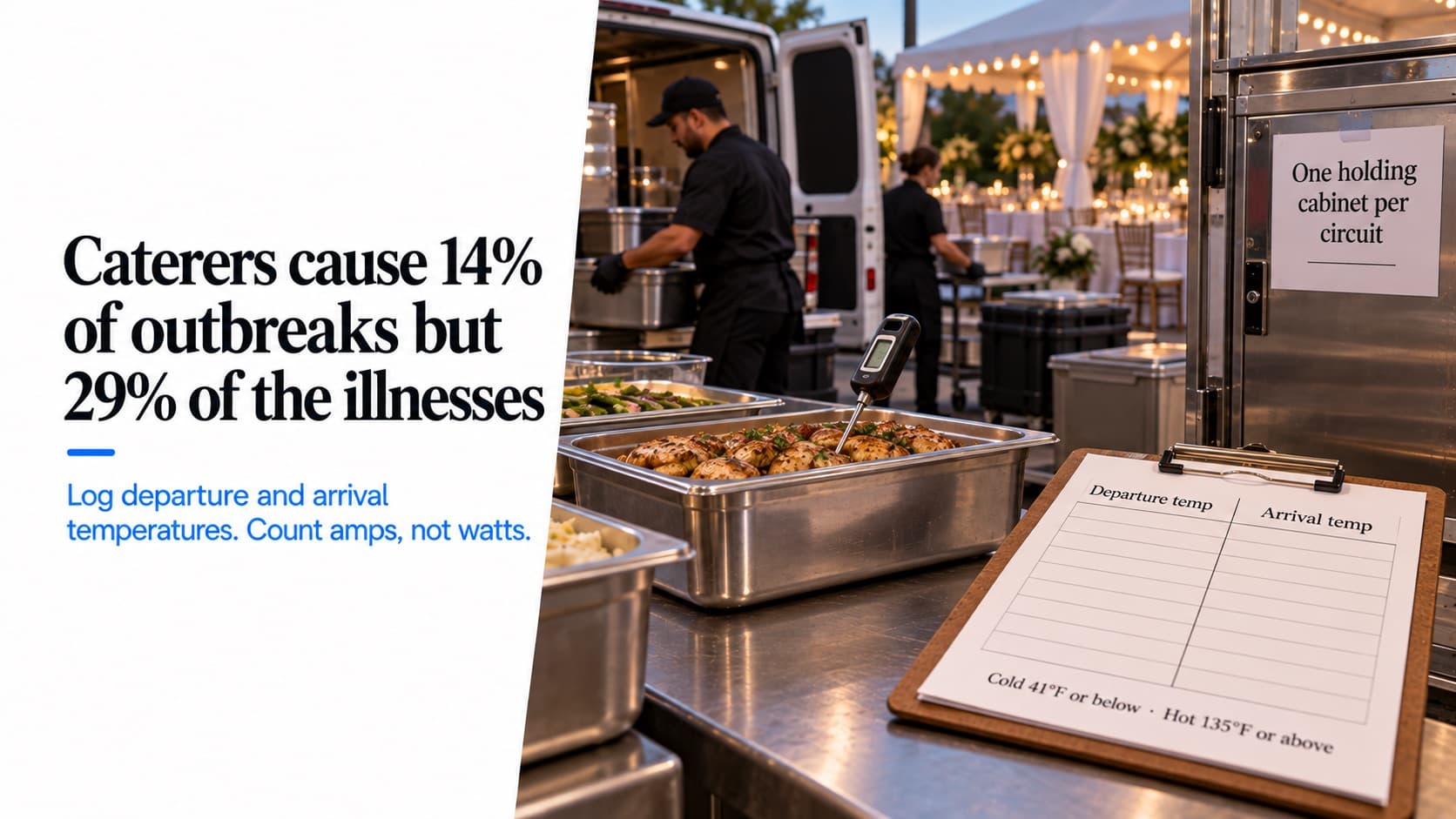
Caterers cause 14% of outbreaks but 29% of the illnesses
California requires departure and arrival temperature logs, kept 90 days. The Food Code gives temporary events just three exemptions.

Most operators I work with can cook for 200 people. What they can't do yet is cook for 200 people ninety minutes from their walk-in, with one convection oven, a generator, and a load-in that started forty minutes late.
That gap is most of what goes wrong off-site, and the federal outbreak data shows why it matters more than it looks. In the CDC's 2017 annual report, among outbreaks with a single known place of food preparation, catering and banquet facilities were 14% of the outbreaks and 29% of the illnesses. By my arithmetic that's about 34 people sick per catering outbreak, against about 11 per restaurant outbreak. It's not that caterers are three times as careless. It's that everyone at an event eats the same food at the same time. The 14% share was the same in the CDC's 2013 summary, so this isn't one bad year.
A study in Public Health Reports modeled what a single outbreak costs a restaurant: from about $8,000 to $2.2 million for casual dining. That's the downside you're managing with everything below.
Temporary events get almost no relief
The FDA Food Code names caterers directly. A food establishment includes a "satellite or catered feeding location" and a "catering operation if the operation provides food directly to a consumer." The 2026 edition, released on September 17, also added "commissary" to that definition, so a commissary is itself a permitted food establishment. Most states still run on the 2022 edition plus its 2024 supplement, so name the edition when you talk to your inspector.
A temporary food establishment is one that operates for no more than 14 consecutive days in conjunction with a single event. Here's what caught me off guard when I read it closely: across the whole Code, temporary events get three accommodations. Exposed studs and rafters are allowed in moist areas. Screens or air curtains can replace self-closing doors. Water doesn't have to be under pressure. That's all.
Holding temperatures, cooling, handwashing, date marking, employee health: every substantive requirement applies in full. And the Code directs inspectors to visit temporary operations more often when the facilities are improvised or the staff are inexperienced.
Where you're allowed to prep
Not at home. A private home "may not be used for conducting food establishment operations," and food prepared in one "may not be used or offered for human consumption in a food establishment." Both are Priority items. None of the Code's narrow home exceptions reaches a caterer.
California is the most specific state I found. All food, before off-site service, "shall be stored and prepared at the permanent food facility." Alameda County won't issue a caterer permit without a signed commissary agreement, verified by the commissary's owner, and specification sheets for the equipment that will keep food at temperature in transport.
Transport is inspected, and California wants the log
The FDA's guidance tells inspectors to check holding temperatures at every inspection, and that explicitly "includes the temperature of TCS food during transport," naming "off-site catering events." It also says infrared thermometers aren't consistent with the Code for verifying holding temperatures, because they read the surface. Use a probe.
Receipt at the site follows the same rule: cold at 41°F or below, hot at 135°F or above, and no evidence of previous temperature abuse.
California goes much further, and it's the most concrete off-site obligation in the country:
- Written procedures filed before you cater, covering transport, limited prep on site, temperature maintenance, cleaning and handwashing.
- A transport vehicle with a smooth, washable, impervious interior where no liquid waste can drain onto the street.
- Records for every off-site event, kept 90 days: location, date, time, client, whether you delivered or served, the full menu, and "departure and arrival food temperature logs for transportation, and corrective action taken if the food arrived out of temperature."
If you're not in California, adopt the log anyway. A departure and arrival temperature on every hotel pan is the cheapest evidence you'll ever collect, and it's the first thing anyone asks for after a guest gets sick.
One more thing about insulated carriers. The best-known manufacturer publishes a hold time of "4+ hours" with no ambient temperature, no starting food temperature and no test protocol, and the more precise figures on distributor listings contradict each other. There is no published number for how long a carrier keeps food above 135°F. Preheat it, load it hot, and measure at arrival. Don't plan around a hold time you can't verify.
Power is an amperage problem, not a wattage one
This is where off-site kitchens fail most visibly, usually at 6:15pm when the second hot box trips the breaker.
- One holding cabinet per circuit. A common double-cavity low-temperature cabinet draws 16 amps at 120 volts — 80% of a standard 20-amp circuit.
- Capacity scales, amperage doesn't. One manufacturer's 4-pan and 28-pan holding cabinets both draw 19.1 amps, each on its own 20-amp circuit. A bigger cabinet isn't a bigger electrical problem; a second cabinet is.
- Countertop convection ovens often need 208 to 240 volts. One full-size model draws 20.8 to 24 amps on a NEMA 6-30 plug. Most venue service entrances don't have that outlet. Ask before you load the van.
- Nameplate isn't running load. The same holding cabinet rated at 1,900 watts idles around 273 watts in its Energy Star test. Size a generator by adding the running watts of everything on at once, then the single largest starting surge. Sizing off nameplates wastes money; ignoring starting surge trips breakers.
Water and handwashing, and the three different temperatures
The Food Code requires handwashing sinks to deliver water at 85°F. A lot of caterers remember 100°F; that was the old federal figure and it survives only in state codes. California requires 100°F to 108°F where the temperature isn't adjustable at the faucet. One Washington county requires 100°F to 120°F. If you cater across a state line, check which one you're under.
For events without plumbing, the Code allows bottled water, closed portable containers, a vehicle tank, an on-site tank, or hoses from an approved source, sized to peak demand. California puts numbers on it:
- At least 5 gallons of water exclusively for handwashing per temporary facility.
- At least 25 gallons for food prep and warewashing.
- Delivery of at least one gallon per minute to each sink basin.
- A wastewater tank 50% larger than the potable water tank.
- One toilet per 15 employees within 200 feet of the facility — the requirement nobody mentions until the venue's restroom is a quarter mile away.
Texas counties publish their own versions, typically an insulated container of at least five gallons with a spigot that stays open so both hands are free.
Fire: the rules around a chafing dish
Chafing fuel is where caterers most often break a fire code without knowing it. The university fire rules I found agree on the basics:
- A non-combustible surface under every chafing dish, extending at least eight inches beyond the fuel can.
- Three feet between the fuel and anything combustible — napkins, paper plates, plastic cutlery.
- Attended at all times, never carried lit, never lit from another can.
- In California campus rules, a 10-pound ABC extinguisher within ten feet of the serving table, and chafing fuel only with fire-marshal approval.
Propane has its own. Closed vehicles like vans may carry cylinders only while their total capacity is under 108 pounds — about five 20-pound tanks. Tents go at least 20 feet from buildings.
Load-in and what the venue won't provide
The only published arrival windows I found come from one university caterer's off-premise policy: 30 minutes before start for drop-off, an hour for a reception or hot buffet, 90 minutes for a full plated meal or anything with multiple bars. Treat them as one venue's standard, not an industry rule. For a plated wedding I'd call 90 minutes tight.
Read the venue's list of what it doesn't do. That same policy is blunt: it provides no tables or chairs for off-premise service, and the caterer handles setup, teardown, garbage and removal.
Two venue realities that change the whole plan:
- Exclusivity. At some large venues the question is moot. The Javits Center, for instance, requires all food and beverage to be purchased through its in-house hospitality brand; outside service is "strictly prohibited" unless authorized.
- Insurance is a bracket, not a number. A university vendor agreement asks for $1 million per occurrence, $2 million aggregate and a $1 million umbrella. A major convention center asks for the same base limits with a $5 million umbrella plus $1 million in employer's liability. Know which one you're signing before you bid.
Rentals: load-out is where the invoice comes from
A rental company's published estimating guide suggests 1 to 1.25 dinner plates per guest for a casual buffet, 1.5 to 2 where seconds are expected, one water glass per guest as a baseline, one wine glass for moderate service, up to two wine glasses and a flute for multi-course dinners, and 15% to 25% more glassware for bar stations. Add a 10% to 20% buffer.
The detail worth knowing is in the damage waiver. One large rental company charges 4% of the order, non-refundable, and it covers "broken glassware or chinaware, stained linen, dented trays." It does not cover theft or missing equipment, which is billed at replacement cost. So the expensive invoice isn't from breakage. It's from a rushed load-out at midnight where half a rack of flutes never made it back on the truck. Count out, count in.
What I'm not going to give you
A hold time for insulated carriers. Covered above.
A generator size for your event. The method is sound; the kilowatt figures in circulation come from non-US retailers and forums.
A burn time for chafing fuel or indoor propane quantity limits. I couldn't get either from a primary source.
A standard load-in time in hours. The only sourced windows are one venue's.
What to do before the next off-site event
- Write your off-site procedures now, even if your state doesn't require filing them. Transport, holding, cleaning, handwashing.
- Log a departure and arrival temperature for every pan, with a probe, and keep the log for 90 days.
- Walk the venue's electrical before you bid: circuit count at the service area, amperage, and whether there's a 240-volt outlet.
- Put one holding cabinet on each 20-amp circuit.
- Know your handwash temperature by state, and bring enough water for handwashing separately from prep.
- Pack the chafing kit with its fire kit: non-combustible mats, an ABC extinguisher, and nobody lighting cans from each other.
- Count rentals out and back in, by rack.
Disclosure: I work at Katalyst, which sells restaurant and catering software, and I keep a laminated card in my kit for the fourteen minutes after the last guest sits down. Software can hold your temperature log and your rental counts, which beats a clipboard in the rain. It can't tell you the venue has one outlet by the loading door, so walk it first.
Related Katalyst products
Topics
See how Katalyst handles your service style
A 30-minute walkthrough of the platform, tuned to how your restaurant actually runs.