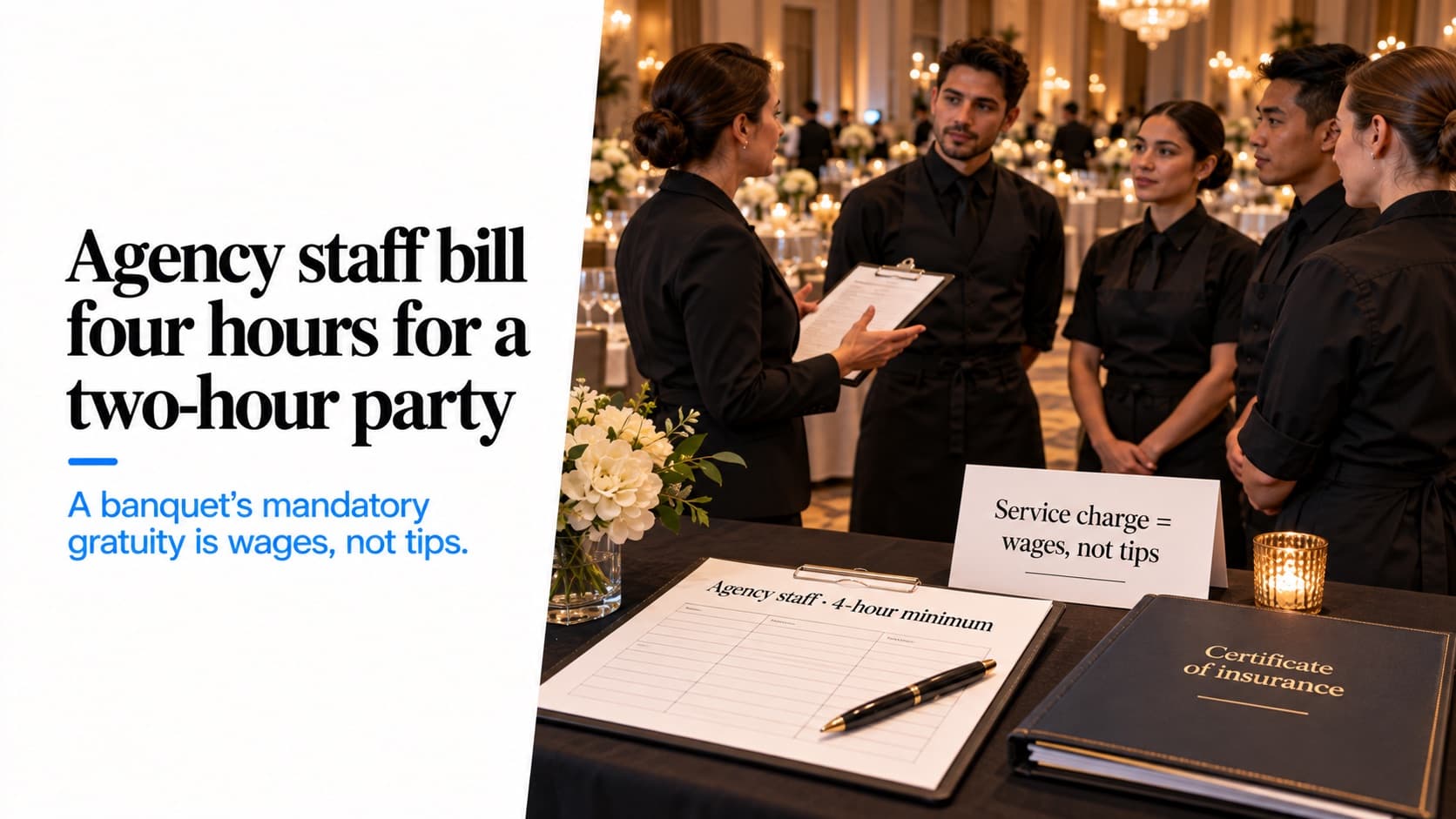
Agency staff bill four hours for a two-hour party
Qwick paid $2.1 million and must treat its California workers as employees. A banquet's mandatory 'gratuity' is wages, not tips, under federal rules.

December is when every caterer runs short of servers. The answer is usually an agency or an app: book eight bartenders and twelve servers for Saturday, pay one invoice, done. It works. It also changes who's responsible for those people in ways the invoice doesn't show.
Here's what agency staff actually cost, and the four questions — minimums, joint employment, tips and injuries — I'd settle before booking.
What agency labor bills at
| Source | Rate | Minimum | Cancellation |
|---|---|---|---|
| Carnegie Mellon dining (2026) | Server $175, bartender $275 per 4 hours | 4 hours | 50% inside 5 days, 100% inside 24 hours |
| Nashville hotel banquet menu | $175 per attendant, plus service charge | Per event | — |
| Hershey Lodge | $25 per server per hour for butler passing | — | — |
| Boston-area staffing agency (older page) | $30 an hour per staff member | 4 hours | 50% of the minimum inside 48 hours |
| Staffing company's 2026 report | $52 billed for a $35 wage, as an example | — | — |
The pattern is the minimum. Every published rate sheet that states one uses four hours. A two-hour cocktail reception staffed through an agency is billed as four hours a head. If you have your own staff for the first two hours and need extra hands for the last two, the agency is the expensive half.
The staffing company's example — a $35 wage inside a $52 bill rate — shows what the markup covers: employer taxes, workers' comp, liability insurance and the coordinator. It's their example, not an industry average.
Who's the employer
When you set an agency worker's schedule, supervise them closely and keep their time records, you may be their joint employer — responsible with the agency for wages and overtime. The rules are in flux:
- Wage law (Labor Department): a proposal published in April 2026 lists four factors: whether you hire or fire, supervise and control the schedule or conditions "to a substantial degree," set the pay, and keep the employment records. As of this writing I found no final rule.
- Labor law (NLRB): since February 27, 2026, joint employment requires "substantial direct and immediate control" over essential terms, and not control "exercised on a sporadic, isolated, or de minimis basis."
The practical reading: a banquet captain directing an agency crew for one night is close to the line, not over it. Running the same crew every week, setting their hours and keeping their timesheets is much closer. Let the agency keep the time records.
Contractor or employee
Some staffing apps classify workers as independent contractors. That choice has been tested:
- Qwick paid $2.1 million to settle with San Francisco's city attorney in 2024 and must reclassify its California workforce as employees.
- Instawork was fined more than $2.3 million by Denver's labor office in 2024 over thousands of wage-law violations, and in 2025 agreed to pay Colorado $400,000 and stop offering contractor shifts there.
The federal contractor test is moving too: the Labor Department stopped enforcing its 2024 rule in 2025 and proposed replacing it in February 2026. California's ABC test applies regardless. If the app's workers are contractors, the "occupational accident" coverage they carry isn't workers' comp.
The gratuity isn't a tip
This catches caterers who mix agency staff with their own. Federal wage rules say directly that "a compulsory charge for service, such as 15 percent of the amount of the bill... is not a tip," and name banquets as the example. The IRS treats "required gratuities included in a contract or invoice" as service charges, paid out as wages.
So the 22% "gratuity" on your banquet contract is wages, wherever it goes. And whether agency staff can share in a tip pool with your own employees is a question the rules don't answer — a mandatory pool is limited to the employer's employees, and agency staff aren't yours. I'd take that one to counsel rather than guess. The tip-pooling post covers the rest.
Who covers an injury
Normally the agency carries workers' comp. Many states also treat you as a "special employer" when you direct the work, which can protect you from a lawsuit if the agency's coverage applies — Texas and New Jersey courts have said so. It varies by state. Get the agency's certificate of insurance before the event, not after someone slips in the dish pit.
Bartenders add one more layer. A California alcohol appeals decision held a licensee responsible when a patron reasonably relied on the person behind the bar, whoever employed them. The bar liability post covers the rest.
What I'd put in the agency agreement
- The minimum and the overtime rule, in hours.
- Who keeps time records — the agency.
- Workers' comp and liability certificates, naming you.
- Alcohol certification for every bartender.
- How the service charge is handled for their staff.
- The cancellation schedule, in days.
- Employee status confirmed in writing for app workers.
What I'm not going to give you
A typical agency markup. None of the large apps publish one.
The final federal rules. Neither the joint-employer nor the contractor rule was final when I checked. Look again before relying on either.
A ruling on agency staff in tip pools. There isn't one.
What to do
- Use agencies for full shifts, not the last two hours.
- Let the agency supervise its own records.
- Confirm employee status with any app you book.
- Collect insurance certificates before the event.
- Keep the service charge out of tip pools that include agency staff until counsel says otherwise.
For how many staff you need in the first place, see event staffing ratios.
Disclosure: I work at Katalyst, which sells catering software, and I still pick up a handful of events a year — sometimes as agency staff myself. The agency crews that work well are the ones whose captain knows the room before the doors open.
Related Katalyst products
See how Katalyst handles your service style
A 30-minute walkthrough of the platform, tuned to how your restaurant actually runs.