North Carolina waives box labels if your staff hand them out
New York's allergen-label law for prepackaged food takes effect in November. Time control allows four hours out of temperature, then the food is discarded.

Three hundred boxed lunches for an 11:30 break looks like the easy job on the calendar. No plating, no chafers, no servers on the floor. In my experience it's the order with the most ways to go quietly wrong: a box with the wrong sandwich for the guest with a sesame allergy, a delivery that sat in a loading dock for ninety minutes, a stack of unlabeled boxes an inspector reads as packaged food.
Two of those are rules, and the rules are less settled than the job looks.
Does a boxed lunch need a label?
The model Food Code says food "packaged in a food establishment" has to be labeled: name, ingredients, net quantity, who made it, and the source of each major allergen. That's a full retail label.
But its definition of "packaged" leaves out food "wrapped or placed in a carry-out container... upon consumer request." The FDA's allergen labeling guidance says the same: the rules don't apply to food placed in a container "in response to a consumer's order, such as the paper or box used to transport a sandwich."
So a sandwich boxed for the person standing at your counter needs no label. Three hundred identical boxes made the night before for a conference, ordered by an office manager who won't eat any of them, and set out on a self-serve table look a lot more like packaged food on display. No federal document settles that case. The inspector in front of you does.
North Carolina's answer: who hands it out
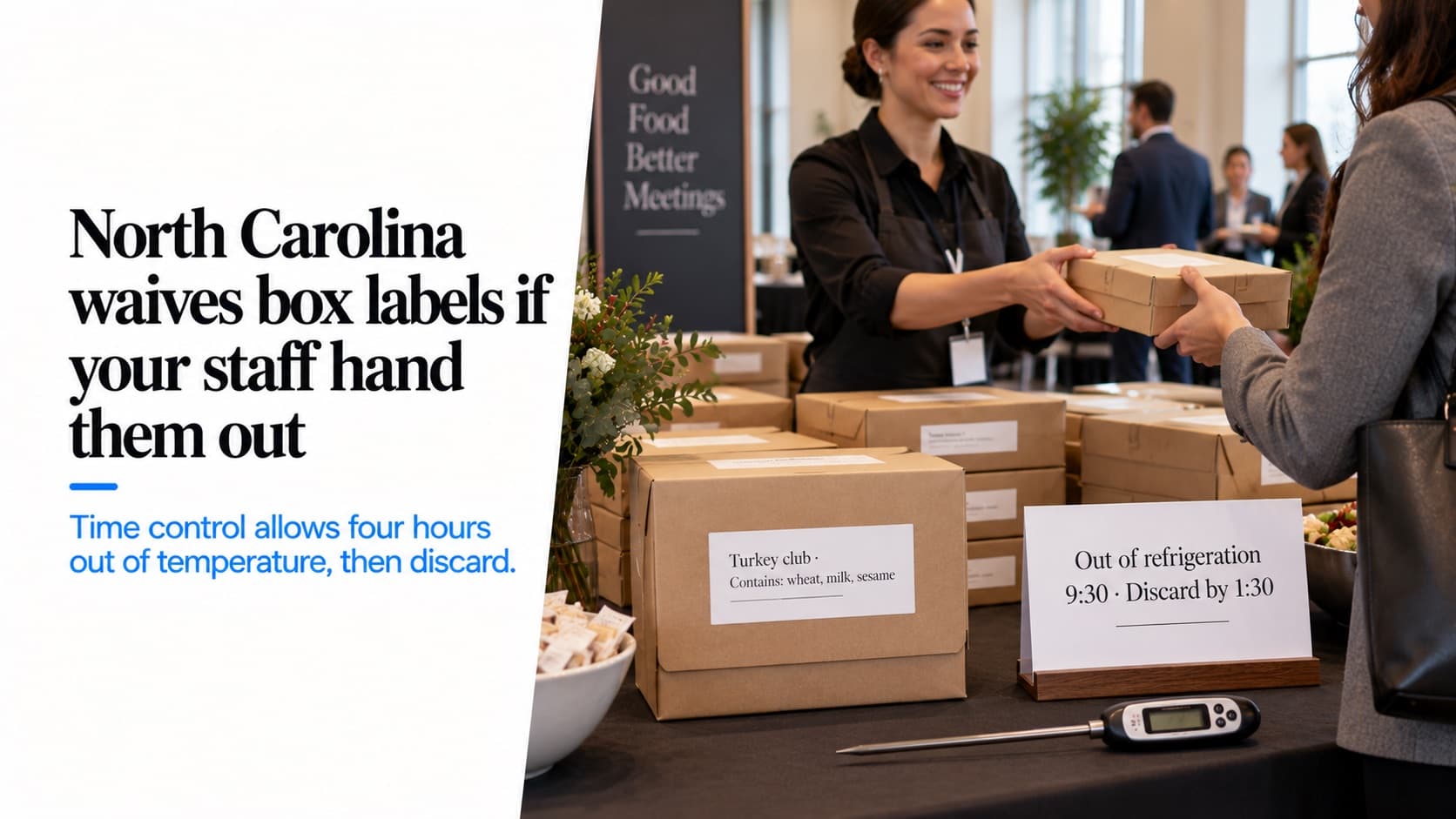
The clearest written state position I found is North Carolina's. Packaged food taken to an off-site location "must meet labeling requirements unless handed out by a food employee of the food establishment that packaged the food." Self-service lines need labels unless they're "continually manned."
That's the operational point. Staffing the handout can change the labeling obligation. Drop the boxes and leave, and they need labels. Put one of your people behind the table handing them out, answering "what's in this?", and in North Carolina they don't. It's a 2014 document based on an older code, so check your own state, but the logic — can the guest ask someone? — runs through the federal rule too.
New York changes next month
New York signed a law in November 2025 requiring every food establishment to "label all prepackaged food" with any major food allergen. It covers places that prepare food for off-premises consumption: delis, bakeries, sandwich shops, cafeterias, food trucks. It takes effect one year after signing, so in November.
It excludes food "packaged after a customer orders." That's the same gray zone as above, and nobody yet knows how New York inspectors will treat a catering order placed a week ahead.
California's new allergen disclosure law, in force since July, applies only to chains with 20 or more locations and exempts temporary food facilities, so most caterers aren't covered.
Nine allergens, and "nuts" isn't one
Since January 2023 the major allergens are milk, egg, fish, crustacean shellfish, tree nuts, wheat, peanuts, soybeans and sesame. On a label, fish, shellfish and tree nuts have to be named by species: "cod," "shrimp," "almonds," not "fish" or "nuts." And "may contain" isn't a substitute for keeping allergens apart; the FDA says advisory statements must be "truthful and not misleading." The allergen post covers the kitchen side.
The four-hour clock starts at your walk-in
Most boxed lunches spend time out of refrigeration, and the Food Code allows that under "time as a public health control." The rules are specific:
- Four hours. Food starts at 41°F or below (or 135°F or above for hot food), is marked with the time four hours after it left temperature control, and is served or thrown out at that time. "Food in unmarked containers or packages... shall be discarded."
- Six hours, cold only. Food starting at 41°F or below can go up to six hours if it never passes 70°F. You have to check the warmest portion, mark both times, and discard anything over 70°F.
- Written procedures, in advance. They have to exist before the event and be shown to an inspector on request.
The catch is when the clock starts. If the boxes come out of your walk-in at 9:30 and ride in an unrefrigerated van, the four hours started at 9:30, not when they reached the venue. An 11:00 delivery for a 12:30 break is three hours into its four by the time anyone eats. Keep the boxes cold in transport and you can start the clock on site.
The mayonnaise isn't the problem
Every caterer has a client who's nervous about mayo. A University of Georgia study reported in 1997 found commercial mayonnaise actually lowered Salmonella counts in chicken and ham salads; the lead researcher called the fear "an old wives' tale." The risk is the chicken, the egg and the time out of temperature — mayo loses acidity once it's mixed into less acidic food. Treat the protein as the hazard and the clock as the control.
Date marks only after 24 hours
Ready-to-eat food held more than 24 hours needs a date mark, with day one being the day it was made. Boxes assembled the night before for a 7 a.m. load-out don't, unless they'll be held past 24 hours. The roasted chicken you prepped on Monday for a Thursday order does.
What published policies do
University caterers publish the most specific boxed-lunch terms:
- UC San Diego: order five business days ahead, minimum 20, no changes inside two business days, and meals "not picked up within 8 hours will be donated."
- SIUE: minimum 10, "maximum of three different types" per order, $12.50 a person, and three business days' notice for dietary needs.
- Bryn Mawr: minimum five per selection, maximum three selections.
The pattern is the cap on variety. Three sandwich types per order isn't about menu design. It's how you assemble 300 boxes correctly and hand the right one to the right person.
How I build 300 boxes
This is my practice, not a rule:
- Label every box anyway — sandwich name and its allergens. It costs a printer and removes the labeling question in any state.
- Cap the variety at three, plus individually named special meals.
- Keep the boxes cold until they leave the van, and mark the time they come out of refrigeration.
- Carry the written time-control procedure and a probe thermometer in the van.
- Staff the handout when you can. One person behind the table answers the allergen question and, in some states, the labeling one.
- Plan for the leftovers before the event.
For queues at the handout table, see the conference break post. For transport, see off-site kitchen logistics.
What I'm not going to give you
An assembly rate in boxes per hour. I couldn't find one with a method behind it, and mine depends on the menu.
"200 boxes handed out in five minutes." That's a catering marketplace's claim.
How New York will treat pre-ordered catering boxes. The law takes effect next month and the guidance isn't out.
What to do
- Find out how your state treats boxed lunches for events, and whether a staffed handout changes it.
- If you cater in New York, prepare allergen labels before November.
- Write your time-control procedure and keep it with the order.
- Name allergens by species on anything you label.
- Cap the variety on large orders.
Disclosure: I work at Katalyst, which sells catering software, and I still pick up a handful of events a year. The tool that matters most on a boxed-lunch job is a label printer and a clock.
Related Katalyst products
Topics
See how Katalyst handles your service style
A 30-minute walkthrough of the platform, tuned to how your restaurant actually runs.