Orlando prices conference breaks for 30 minutes, not 45
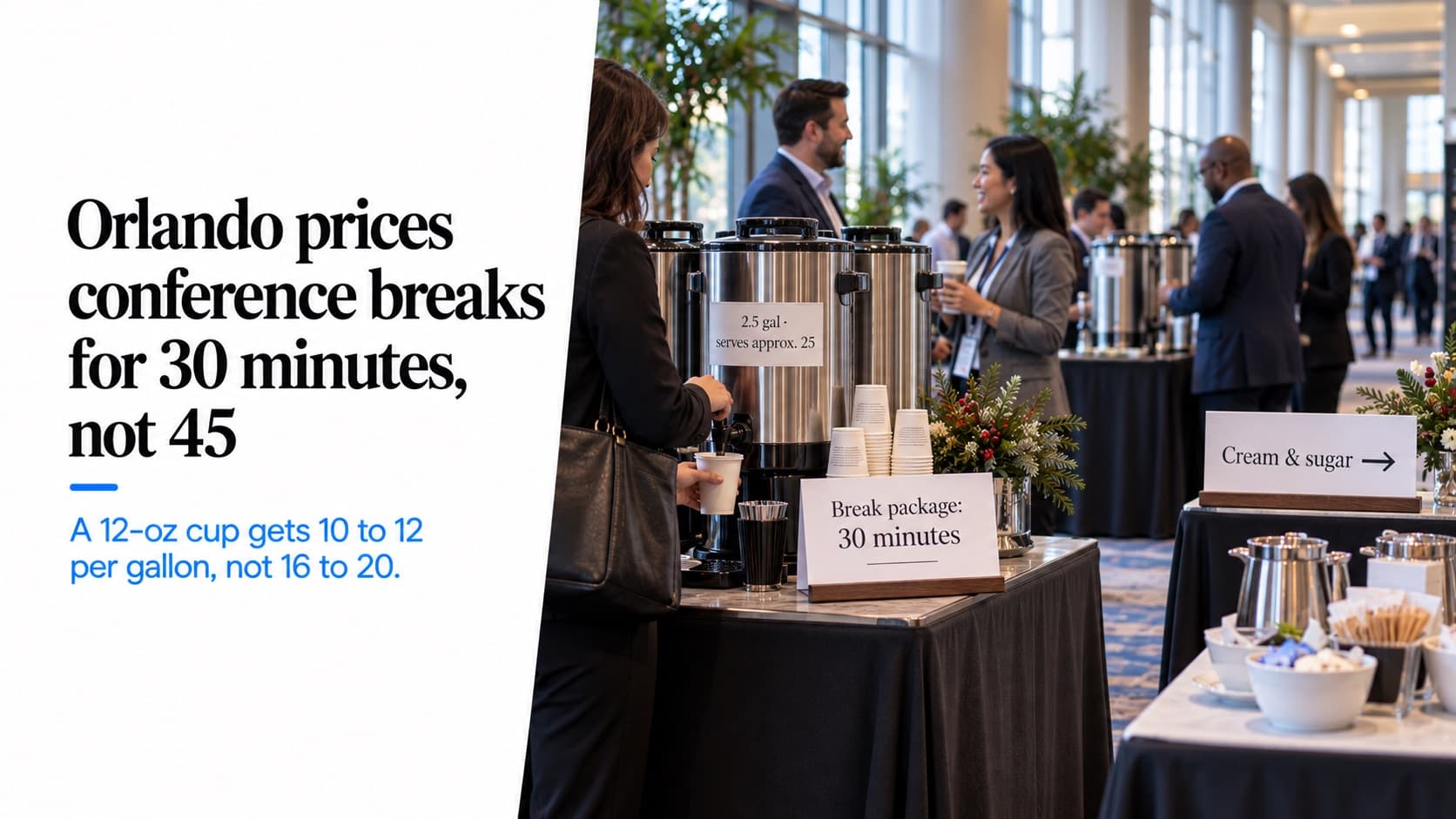
Convention centers that price 12-ounce cups get 10 to 12 per gallon, not the 16 to 20 most guides use. Attended stations bill a four-hour minimum.

A conference break fails twice. At minute five, when 500 people come out of the same ballroom at once and stand in one line for one urn. And at minute thirty-five, when the urns are empty and the session hasn't started. I've worked both failures, sometimes at the same break.
Neither is a food problem. They're arithmetic: how much the venue actually stocks, how much a gallon of coffee actually pours, and how long each person spends at the station. The published convention center menus answer more of that than most planners realize.
Break pricing assumes a 30-minute break
Orlando's convention center caterer says it outright: "All Breaks are priced based on a menu mix with fixed quantities for an event duration of 30 minutes." And: "Replenished items, with service time above 30 minutes, will be charged on an a la carte basis."
So a 45-minute break bought at package pricing is stocked for 30. The last fifteen minutes is either empty or billed by the item. Continental breakfasts there are priced on an hour.
Time costs money in the other direction too. San Diego's convention center includes up to two hours of service per meal and charges $1.50 per attendee for every extra half hour, plus service charge — including when the start or end moves by 30 minutes or more. Orlando adds labor if the service time changes by half an hour. A keynote that runs long costs money at the buffet.
The gallon is smaller than you think
The rule of thumb in most planning guides is 16 to 20 cups per gallon. That's true for a 6- to 8-ounce cup. Convention centers serve 12-ounce cups.
- Las Vegas: 2.5 gallons "serves approximately 25." That's ten cups per gallon.
- Boston: "1 gallon equals 10-12 servings," sold in 3- and 5-gallon increments.
- University of Iowa: 1.5 gallons serves 20, about 13 per gallon.
A gallon is 128 ounces. At 12 ounces a cup, that's about ten and a half cups, before anyone tops off. For 500 attendees all taking coffee, that's 42 to 50 gallons, not the 25 to 31 the old rule gives you. At $85 to $90 a gallon, which is what Orlando, San Diego and Boston charge, the cup size is a bigger number than the coffee choice.
The line, not the coffee, is the problem
Here's the calculation I use, and I haven't seen a catering source write it down, so treat it as mine. Queueing theory has a simple rule, Little's law: the number of people at a station equals the rate they arrive times how long each one spends there.
If 600 people reach the coffee in the first ten minutes, that's 60 a minute. If each spends 20 seconds at the urn, about 20 people are at the stations at once — roughly ten per side on two double-sided stations. If each spends 40 seconds, because they're also doing cream, sugar and a lid at the same table, that's 40 people at once, and the line backs into the hallway.
That's why the most effective change costs nothing: move the cream, sugar and lids to a separate table a few steps away. Halving the time at the urn halves the crowd. Put tea and water on their own stations so the people who don't want coffee aren't in the coffee line.
For meal functions, the wedding timeline post covers buffet lines, at roughly one line per 50 to 75 guests.
Attended stations bill four hours, even for a 45-minute break
Published labor rates come with a four-hour minimum:
| Venue | Attendant | Minimum |
|---|---|---|
| Las Vegas Convention Center | $240 server; $300 culinary attendant or bartender | 4 hours |
| Orange County Convention Center, Orlando | $225 per station | Up to 4 hours |
| Boston convention center | $43.75 an hour ($175) | 4 hours |
On a 500-person conference, one attendant is 45 to 60 cents a head. On a 50-person meeting, the same attendant is $4.50 to $6 a head before service charge. For small groups, the minimum is the price.
And read the service charge. San Diego's is 23.5%, of which 29.4% is a "house" charge — about 6.9 points of the total that doesn't go to staff. Boston's caterer offers a structure with a 5% administrative fee it keeps. Las Vegas distributes 90% of its 19% to employees.
Breaks have no overset
Las Vegas and San Diego both prepare 5% above the guarantee, up to 30 meals. Las Vegas specifies the overage "applies to buffet meal services only." Breaks are bought by the gallon and the dozen, or as 30-minute packages, so there's no built-in cushion. If you want one, order it.
Boxed lunch or buffet
Boxed lunches cost less at every convention center I checked: $42 against $68 for a buffet in Las Vegas, $38 to $39 in Orlando, $42 to $46 in San Diego. They feel faster, and they let you hand out lunch at several points instead of one line. I couldn't find a published throughput figure to prove that, so I'm not putting a number on it.
What I'm not going to give you
Guests per minute per buffet line. I found no primary source beyond what's in the timeline post.
The share of attendees who take coffee. "Plan for two-thirds" is common advice with nothing behind it. Use the venue's yield and your own past counts.
Attendees per beverage station. No published standard.
How I'd set up a 45-minute break
- Ask the venue what its break package assumes — 30 minutes, or the full break — and price the refresh.
- Order coffee at the venue's yield for the cup it uses, not the planning-guide rule.
- Count stations from arrivals, not attendance: how many people come out of the room in the first ten minutes.
- Put condiments, tea and water on separate tables.
- Schedule the refresh at minute 25, not when the urns run dry.
- For small meetings, check the four-hour minimum before ordering an attended station.
- Release rooms in waves if you can. Two rooms released five minutes apart halve the arrival rate.
Disclosure: I work at Katalyst, which sells catering software, and I still pick up a handful of events a year. The fix that helps most here is moving a table of creamers eight feet, and nobody sells that.
Related Katalyst products
Topics
See how Katalyst handles your service style
A 30-minute walkthrough of the platform, tuned to how your restaurant actually runs.