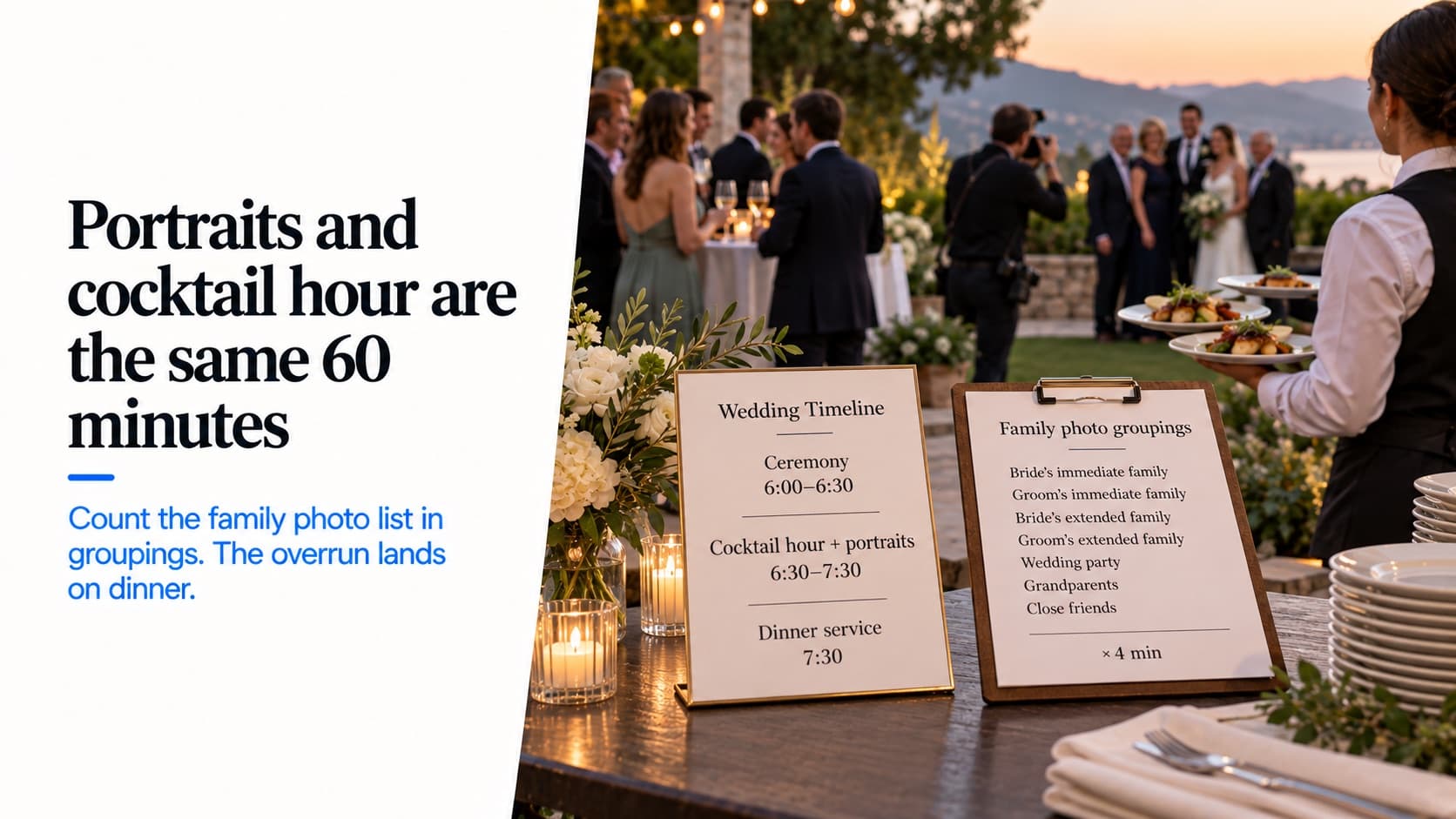
Portraits and cocktail hour are the same 60 minutes
Allow three to five minutes per family photo grouping. One venue publishes plated service at 40 to 45 minutes, from salad to coffee.

Ask anyone who has worked a hundred weddings where the day goes wrong and you'll get the same answer. Not the kitchen. The hour between the ceremony ending and dinner going out.
I spent seven years running a 220-guest venue and I watched it happen the same way every time, and for years I thought it was a discipline problem. It isn't. It's arithmetic, and you can see it in any planner's published timeline if you put two of them side by side.
The structural reason, visible in one document
A planner in the Pacific Northwest publishes two versions of the same wedding day. The first-look version: ceremony 6:00, ends 6:30, cocktail hour 6:30 to 7:30, grand entrance 7:00, dinner service begins 7:30.
The no-first-look version is identical except the couple shoots their portraits during cocktail hour. The grand entrance slides from 7:00 to 7:30, and dinner with it.
That's the whole mechanism. When the couple doesn't see each other before the ceremony, the portrait block and the cocktail hour are the same sixty minutes. There is no slack in that hour, because it was never an hour of slack. It was already spent.
Any photo overrun lands directly on your service start. Not on the dancing, not on the bar, on the moment your kitchen has been holding food for.
Count the photo list in groupings, not minutes
Photographers publish their own numbers and they agree more than anything else in this business:
- About three minutes per grouping, with an immediate-family list finishing in 20 to 30 minutes and a long extended-family list taking up to an hour.
- Four to five minutes per grouping when the group is more than four people.
- Wedding party: 45 to 60 minutes for twelve or fewer, plus about 15 minutes for every four additional people.
So a family list with 25 groupings is an hour. Not "a few photos after the ceremony" — an hour, which is the cocktail hour you were planning to serve food in. Ask for the list, count the lines, multiply by four minutes. That number belongs on the banquet event order.
Build the day backwards from sunset
Photographers do this and caterers mostly don't, which is why the two trades argue about the timeline instead of building it together.
The published formula from one photographer: ceremony about 30 minutes, plus an hour of portraits, plus 15 minutes of margin before sunset, equals 1 hour 45. Which means starting the ceremony roughly two hours before sunset.
Two corrections worth carrying into that conversation:
- "Golden hour" is not an astronomical term. It appears in neither the US Naval Observatory's definitions nor NOAA's solar calculator. Photographers use it for the last hour to hour and a half of usable light, while the shoot itself is usually 20 to 25 minutes.
- Get the sunset time from the Naval Observatory. NOAA's own calculator page says it's "no longer actively supported or maintained" and is provided "for research and entertainment purposes only."
Sunset moves by three hours across a season in most of the country. A June 8:30 sunset and an October 5:30 sunset are different events with the same contract.
Your service clock, in real numbers
Here's what a plated dinner actually takes, from a venue that publishes its own course-by-course timing: salad out, guests need 5 to 6 minutes to eat it, staff 5 minutes to clear. Entrée: 10 to 15 minutes to serve, 10 to eat, 5 to 6 to clear. Coffee, 5. Total: 40 to 45 minutes for the entire plated food service.
That's the floor, not the plan. Two university venues cap what they'll service:
- 90 minutes. "All menus are based upon a 90-minute service period. Food items will be removed at the end of the service period."
- 2.5 continuous hours, and that venue says why: "For food safety and presentation concerns."
At scale the per-course rate stretches. One account of a 300-person plated event puts each course at about 20 minutes for the full room, with five in the kitchen and around twenty on the floor.
Buffet throughput is a line-count problem
If you take one operational number from this post, take this one: one serving line per 50 to 75 guests, at roughly a minute per person. That's about 60 guests through a line in an hour, slower than the hundred-per-hour figure people quote.
The rest follows from table geometry:
- A single 8-foot buffet table serves 20 to 30 people.
- A double-sided line built from three tables serves 50 to 60.
- 100 guests need two lines to clear in under an hour.
- 200 guests need four double-sided lines.
- Allow about two running feet of table per food container.
For a sanity check outside the wedding world: Chicago Public Schools' facility standards require two serving lines for 150 students in a 40 to 60 minute lunch, and three for 225 — an implied 75 to 110 people per line per hour, in a building designed for throughput and staffed by people who do it daily.
And the queueing behavior matters more than the average. As the arrival rate approaches the line's capacity, the wait doesn't rise gently, it runs away. That's why a buffet that "worked fine" at 120 guests turns into a forty-minute queue at 160 with the same setup.
The clock you're really serving
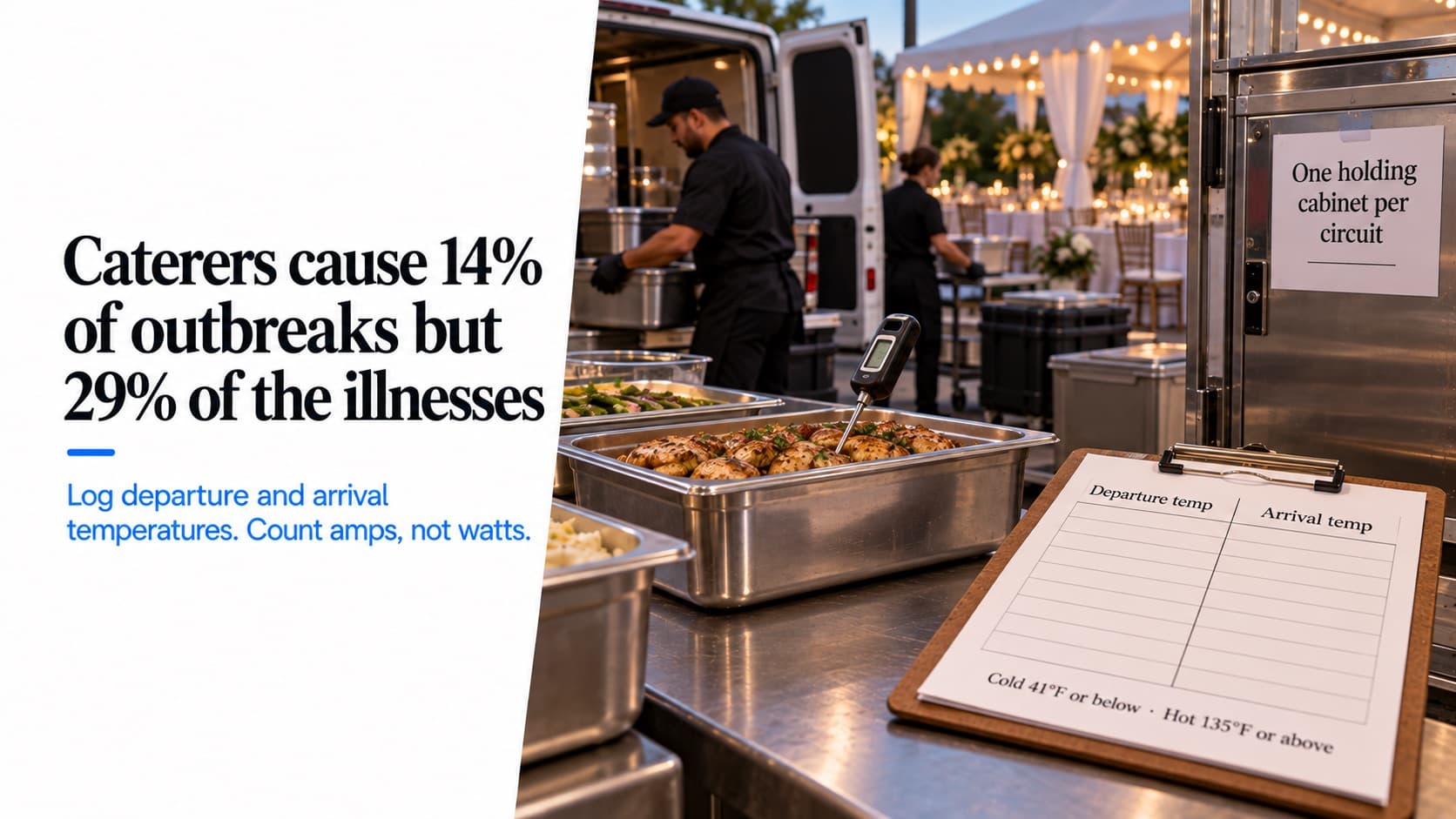
Underneath the timeline is a food-safety clock, and it's the one that doesn't negotiate. Hot food at 135°F or above, cold at 41°F or below.
There's an alternative if you'd rather run on time than temperature. The Food Code allows time as a public health control: food starts at or below 41°F or at or above 135°F, gets marked with a time four hours out, and must be served or discarded within those four hours. Unmarked containers get discarded. The catch is paperwork — written procedures have to be prepared in advance and kept on the premises, which means writing them before the season, not the morning of.
One note on citations, because the ground moved recently: the 2026 Food Code came out on September 17, 2026. Most states are still operating under the 2022 edition plus its 2024 supplement. When you're checking a rule against your health department, name the edition.
Cocktail hour is provisioned per person, not per hour
This is the mistake I see most often in kitchens that are otherwise excellent. The standard published figures are 4 to 6 hors d'oeuvres per person when dinner follows, and 8 to 10 when it doesn't — and those are per person for the whole reception, not per hour. One source says so directly: caterers calculate per person because cocktail hours are usually capped at two hours.
There is one published consumption curve, and it's the useful one: guests eat about five pieces in the first hour and about three in each hour after. Which means a 90-minute cocktail hour provisioned at a flat five pieces a head is short, and it's short during the window when people are drinking and the couple is outside taking pictures.
On the drinking: food in the stomach slows alcohol absorption, which is mechanism, not a number, and I won't pretend there's a figure for how much passed canapés change a room. What I can tell you from the floor is that the complaints at 9pm trace back to an under-catered 6:30.
Feed the vendors when the couple eats
The photographers' association states the standard plainly: a meal "served at the same time as the bridal couple." A published DJ contract clause puts numbers on it — events of four hours or more include one vendor meal served with the wedding party's, and events of six hours or more include a 15-minute break for every three hours of performance.
There's an operational reason beyond courtesy. Vendors who eat when the couple eats are back on their feet when the toasts start. Vendors fed last are eating during the first dance.
What I'm not going to give you
A room-flip duration. Every "flip a ceremony space in 45 minutes" figure I could find traces to content sites. Planners describe the problem; nobody publishes a defensible time.
One correct timeline. The published ones disagree on almost everything except cocktail hour at 45 to 65 minutes and dinner at 45 to 90.
A drinks-per-guest number for the gap. See above.
What to do at the next planning meeting
- Ask whether there's a first look. If not, your cocktail hour and the portrait block are the same hour, and your service start is already at risk.
- Get the family photo list and count the groupings. Multiply by four minutes. Put the result on the BEO.
- Look up sunset for the date at the Naval Observatory, and work the ceremony start backwards from it.
- Commit to a service window and say what happens when the room starts late.
- Build buffet lines by fifties, double-sided, and add a line rather than adding staff to an overloaded one.
- Provision cocktail hour per person on the curve — five in the first hour — not on a flat per-hour figure.
- Write vendor meals into the BEO with a time, not just a count.
Disclosure: I work at Katalyst, which sells restaurant and catering software, and I still pick up a handful of events a year. Software will hold your BEO and your counts. It will not tell you that the couple skipped the first look, which is the single fact that decides whether dinner goes out on time.
Related Katalyst products
Topics
See how Katalyst handles your service style
A 30-minute walkthrough of the platform, tuned to how your restaurant actually runs.