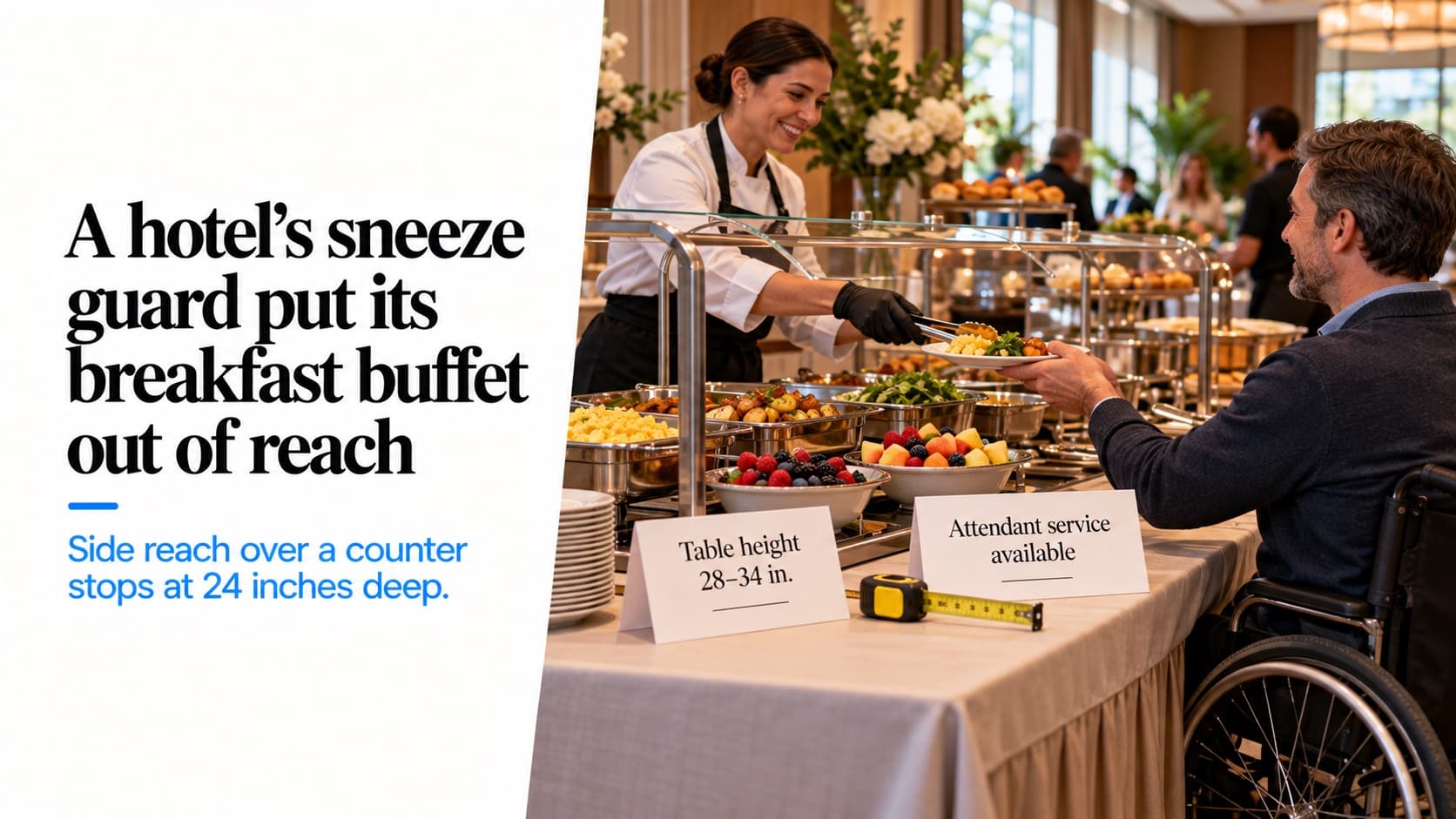
A hotel's sneeze guard put its breakfast buffet out of reach
ADA dining surfaces must be 28 to 34 inches high, and side reach over a counter stops at 24 inches deep. Buffet labels and menus need no Braille.

Most banquet setups fail accessibility in the same three places, and none of them is the ramp. The buffet's back row is out of reach. The "accessible table" is the one by the kitchen door. And the aisles fill with chairs and bus tubs halfway through service.
The ADA's design standards are specific about all three, and they apply to temporary setups more than most people assume. None of this is legal advice; it's what the published standards and the Justice Department's enforcement say.
The numbers that matter
From the 2010 ADA Standards:
| Element | Requirement |
|---|---|
| Dining surface height | 28 to 34 inches |
| Knee clearance under a table | 27 inches high, 30 inches wide |
| Accessible seating | At least 5% of seating and standing spaces, dispersed |
| Forward reach, unobstructed | 15 to 48 inches high |
| Side reach over a counter | Counter 34 inches max, reach depth 24 inches max |
| Self-service shelves and dispensers | At least 50% of each type within reach |
| Accessible route | 36 inches wide |
| Turning space | 60-inch circle |
The standards apply "to temporary and permanent buildings and facilities," and the advisory names stages, platforms and daises. Your head table on a riser is covered. Movable tables and chairs aren't directly covered by the design standards, but the duties below still reach them.
The buffet that failed
The clearest enforcement example I found is a 2017 Justice Department agreement with a hotel restaurant in Cedar Rapids, Iowa. Its breakfast buffet had a sneeze guard and two cold display containers set about 30 inches deep — beyond the 24-inch maximum side reach over a counter that was itself above the limit. Guests in wheelchairs couldn't reach the food. The same agreement cited dining rooms with no accessible tables at all.
That's the typical failure. A 30-inch banquet table with chafers along the back edge and a sneeze guard in front puts the back row out of reach from the side. The fix is usually to bring the items forward or put a person behind the line.
The sneeze guard and the attendant
The Food Code requires food on display to be protected by "food guards, display cases, or other effective means." One county health department's guidance lists acceptable alternatives to a guard, including a "food employee actively monitoring and handing food directly to customers."
The ADA's fallback when a barrier can't be removed is the same idea: provide the service another way, such as "retrieving merchandise from inaccessible shelves." One attendant serving from behind the line satisfies both. For a large buffet, I'd staff that position regardless.
Condiments and utensils follow the same reach rules — half of each type within reach. The conference break post argues for a separate condiment table for speed; set it at table height and it helps here too.
Tables, chairs and the "ADA table"
Standard folding banquet tables are about 29 to 30 inches high, inside the 28- to 34-inch range. Check the knee clearance. An apron or frame can drop the space underneath below 27 inches, so measure your rental stock.
At round tables, the simplest accommodation is the one the ADA National Network recommends: remove a chair so the guest stays in their own wheelchair. And spread those positions through the room. The standards require accessible seating to be "dispersed throughout the space," which rules out the single table by the service door.
Whether movable banquet rounds count toward the 5% figure isn't settled — a 2001 Justice Department letter excluded movable seating under the older standards, and the current wording counts "seating spaces." Treat 5% as the floor regardless.
Rearranging is required — up to a point
For existing spaces, the ADA requires removing barriers when it's "readily achievable," and its own example is "rearranging tables, chairs ... and other furniture." There's a limit written into the same rule: rearranging isn't required to the extent it causes "a significant loss of selling or serving space."
So a 36-inch accessible route through a banquet room is expected. Losing three tables to make it may not be. Plan the route on the floor plan, and keep it clear during service. The rules also require accessible features to be maintained, which a route blocked by a bus cart isn't.
Service animals
Under the ADA rules, a service animal can go anywhere guests are allowed to go, including the buffet line. Staff may ask only two questions — whether the animal is required because of a disability and what task it's trained to perform — and may not ask for documentation. The animal can be removed only if it's out of control or not housebroken, and you're not responsible for caring for it. Only dogs, and in limited cases miniature horses, qualify.
Signs and labels
Menus and temporary signs posted for seven days or less don't need Braille or tactile characters under the standards. The ADA National Network recommends large-print, high-contrast, non-glare labels and a menu at the start of the line. If a guest is blind, an attendant reading the line is the practical answer. The special meals post covers allergen labels.
My setup checklist
- Measure the knee clearance of the rental tables.
- Pull a chair at accessible positions, spread across the room.
- Keep every buffet item within 24 inches of the front edge, or staff the line.
- Put condiments and utensils at table height.
- Mark a 36-inch route on the floor plan, and assign someone to keep it clear.
- Ramp the head table if it's on a riser.
- Brief staff on the two service-animal questions.
What I'm not going to give you
A settled rule on movable rounds and the 5%. The guidance conflicts.
Aisle widths between rounds. Beyond the 36-inch route and 60-inch turn, I found no sourced number.
Sneeze-guard dimensions. The figures in circulation come from equipment standards, not the Food Code or the ADA.
What to do
- Walk the buffet from a seated height before guests arrive.
- Staff one attendant on any line with a deep sneeze guard.
- Disperse accessible seating.
- Keep the route clear all night.
Disclosure: I work at Katalyst, which sells catering software, and I still pick up a handful of events a year. The best accessibility test I know costs nothing: sit in a chair at the start of your buffet and try to reach the last chafer.
Related Katalyst products
Topics
See how Katalyst handles your service style
A 30-minute walkthrough of the platform, tuned to how your restaurant actually runs.