Form-to-email capture ranked worst in the lead-response data
Federal law lets you email an inquiry lead with no prior consent. A marketing text to that same couple needs prior express written consent.

Two numbers circulate in every wedding-sales talk I've sat through. Up to 50% of bookings go to the vendor who responds first. Reply within five minutes and you're nine times more likely to convert.
Both come from Planning.Wedding and WeddingPro, which is The Knot Worldwide's vendor-facing business and sells lead tools to the people reading them. Neither is published with a sample size, a method or a date. I've repeated them myself, years ago, before I went looking for the source and found there wasn't one.
There is real research on response speed. It says something narrower than the slogans, and one part of it, almost never quoted, is about the shape of your inquiry form rather than the speed of your reply. That part changed how I'd build a catering inbox.
What is actually measured
Harvard Business Review, 2011. An audit of 2,241 US companies found that firms attempting contact within an hour of a query were nearly seven times as likely to qualify the lead as those trying an hour later, and more than sixty times as likely as firms that waited a day or more. The distribution is the part worth sitting with: 37% responded within an hour, 24% took more than 24 hours, and 23% never responded at all. Average response time among those who did reply inside a month was 42 hours.
XANT, 2021. 5.7 million leads across 400+ companies: conversion 8x higher when contact happened within five minutes versus six or more. Under 1% of leads were called within five minutes.
One correction, because the number gets inflated constantly. The famous "100x" figure comes from a 2007 study and measures the odds of contacting a lead, not selling to one. That study says so itself: it "did not address close ratios." If you want a figure attached to revenue, use the 8x.
Note also what none of this measures: weddings. Every one of these studies is B2B software sales. The direction is almost certainly right for catering. The magnitude is borrowed.
The forgotten half of the research
The same 2007 project included a survey of 495 companies across 40+ industries, analyzed with regression rather than anecdote. It found the speed effect in percentage points, which is more useful at our scale:
- Each tier of delay in first response — 30 minutes instead of 10 — dropped the share of leads qualified by 4.3%, and close rates by nearly 2%.
- Each additional unproductive contact attempt dropped qualification by 5% and close rates by nearly 1.5%.
- Improving both by one level lifted qualification about 11% and close rates about 5%.
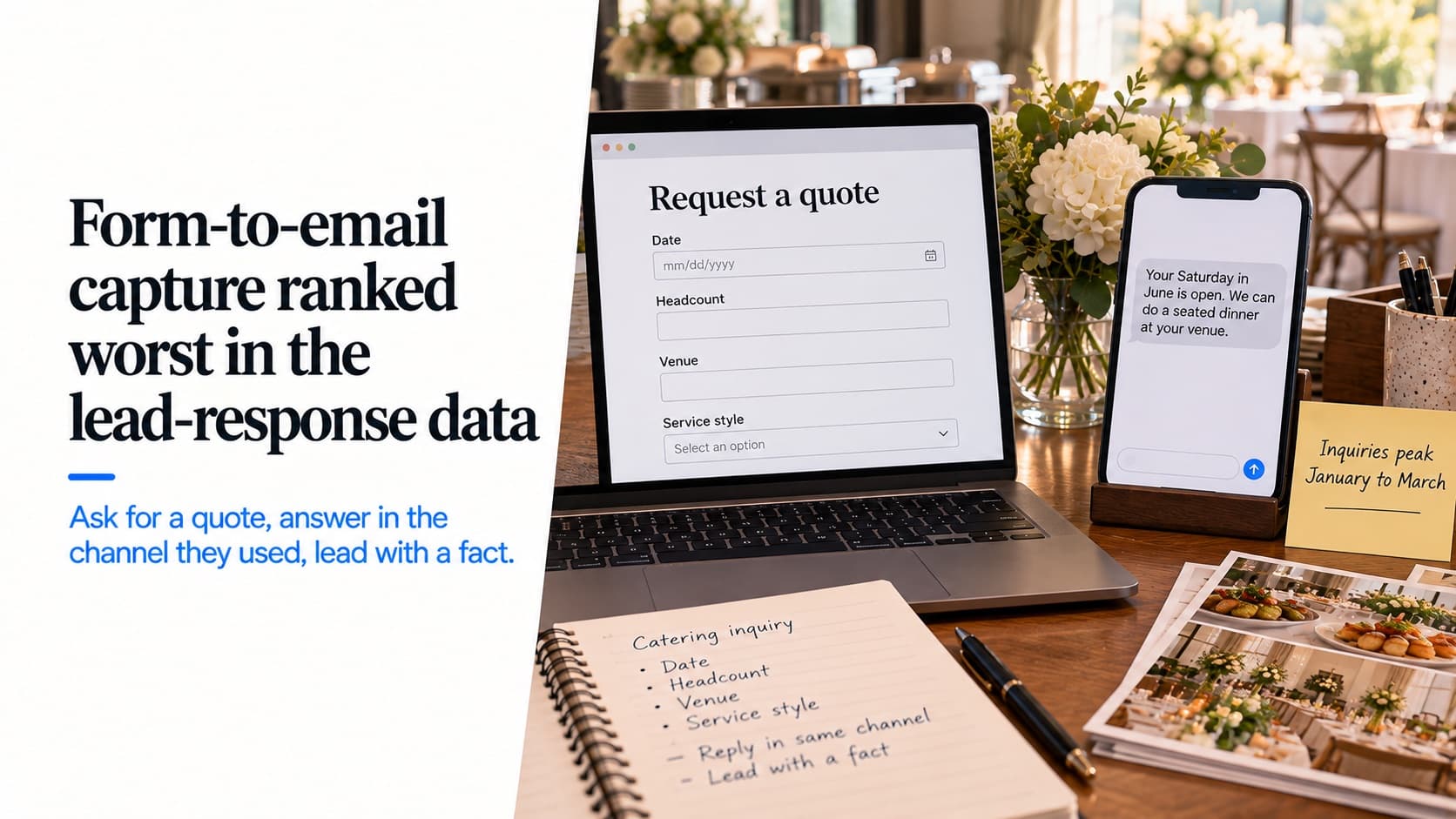
Then the finding nobody quotes. The survey looked at how leads were captured, and a web form that generates an email correlated negatively with both qualification and close rates. Live chat and click-to-call correlated positively with close rates. And the strongest positive of all: sites offering a price quote or a proposal request qualified and closed better, while newsletter signups, webinars and white-paper libraries lowered qualification.
Read that against a typical caterer's site. "Contact us" form, message lands in a shared inbox, someone replies tomorrow with a PDF menu and a request to schedule a call. That is the exact pattern the data ranks worst, executed slowly.
What it implies for a catering inbox
Ask for a proposal, not a message. The form should collect date, headcount, venue and service style, and its button should say what the couple gets: a quote, a date hold, availability. The research says quote-request forms outperform contact forms. It costs nothing to change the framing.
An auto-reply is not a response. It collapses time-to-first-touch, which is real and worth having, but the measured effect lives in qualification — a human deciding whether this is your event and saying something specific about it. An auto-reply that promises a reply within 24 hours has made a promise, not a contact.
Answer in the channel they used. If they typed a mobile number and asked about a Saturday in June, a text that answers about that Saturday beats an email with an attachment. Live chat and click-to-call are the two capture methods the data associates with better closes.
Make the first human message carry a fact. Your availability on their date, a starting per-person range for their service style, or the one question that decides whether you can serve their venue. A reply that only asks to schedule a call is a delay wearing a greeting.
Your inbox has a season
The inquiries don't arrive evenly, and the pattern is set by engagements rather than weddings. About 47% of couples get engaged between November and February, December alone accounts for roughly 19% of proposals, and December 25 is the single most popular day, with December 24 close behind.
So the flood is January to March. Average engagement runs 14 months, and 82% of couples book the venue first, which means the caterer inquiry usually arrives after the venue is set and the date is fixed. That's also why your answer can be specific: you know the room, the date and often the vendor list before you write a word.
Staff the inbox for that curve. A response-time policy that works in September will fail on the second Monday of January.
Email and text are not the same legal question
This is the part I see caterers get wrong most often, and the asymmetry is stark.
Email. Federal law requires no prior consent to send a commercial email to someone who inquired. What it requires is honest headers and subject lines, identification as an advertisement where applicable, a valid physical postal address, a clear opt-out, and honoring opt-outs within 10 business days. Penalties run to tens of thousands of dollars per violating email, so treat the unsubscribe link as load-bearing.
Text. Different regime entirely. A couple who types their mobile number into your inquiry form has, under longstanding FCC reasoning, given consent to be contacted about that inquiry — the reply, the quote, the tasting confirmation. District courts have split on applying that to texts, so it isn't as settled as vendors imply. What is settled: a marketing text — the seasonal menu, the "our fall dates are filling up" nudge to a couple who went quiet — requires prior express written consent, meaning a clear disclosure and an affirmative act, not a pre-checked box.
And since April 2025, a revocation request must be honored as soon as practicable, and no later than 10 business days, by whatever reasonable method the person uses. "Stop" in a text thread counts.
The practical version: reply to the inquiry however they contacted you. Before you add anyone to a list that gets promotional texts, collect consent for that separately and keep the record.
What I'm not going to give you
A conversion benchmark. Every figure in circulation — 15–30%, 25–40%, 10–20% for venues — comes from software and agency blogs with no stated method. I couldn't find one defensible inquiry-to-booking rate for catering. Measure your own and compare it to last year.
A personalization lift number. The "personalized subject lines increase opens by 30%" genre all traces back to marketing platforms. Speed is evidenced. Personalization is asserted.
The 50% and the 9x. See the top of this post.
What to do this week
- Measure your own first-response time for the last 20 inquiries, in hours. Most people are surprised, and 23% of companies in the HBR audit never replied at all.
- Rewrite the form as a quote request, with date, headcount, venue and service style, and a button that names what they'll receive.
- Decide who owns the inbox on Saturdays, because that's when couples write and when your team is working an event.
- Put one fact in the first reply. Availability, a range, or the question that decides it.
- Separate your reply channel from your marketing list, and collect written consent before any promotional text.
- Staff January through March like the season it is.
Disclosure: I work at Katalyst, which sells catering software with proposals and deposits in it, so a post about inquiry pipelines is self-serving by construction. The two things I'd actually change first cost nothing: the wording on your form, and who is responsible for answering it on a Saturday.
Related Katalyst products
See how Katalyst handles your service style
A 30-minute walkthrough of the platform, tuned to how your restaurant actually runs.