Restaurant email and SMS marketing: turning your guest list into repeat visits
Why owned channels beat paid, the open-rate and ROI numbers, how to build the list, the automations that matter, and the consent rules you can't skip.


The cheapest marketing you own is the guest who already ate your food and liked it. Getting them back doesn't require outbidding a delivery app for attention or renting reach from a social platform's algorithm — it requires a phone number or an email address and the discipline to use it well. Email and SMS are the two channels a restaurant actually owns, and they're the highest-ROI marketing most independents run worst, if they run them at all.
I'll give you the numbers, the way to build the list, the handful of automations that do most of the work — and the consent rules you genuinely cannot skip, because the fines are per-message.
Why owned channels win
The economics are lopsided in your favor. Email marketing returns a widely-cited ~$36 for every $1 spent (an older benchmark recycled across the industry, so directional — but consistently large). And SMS gets read: text open rates run around 90–98% versus roughly 20–43% for email, with response rates far above anything social delivers. Restaurant-specific email benchmarks land near a 43% open rate — high, because a guest who gave you their address actually wants to hear about the special.
Compare that to a delivery marketplace, where you pay 25–30% commission to reach a customer the platform owns. Email and SMS reach a customer you own, at nearly zero marginal cost. The whole game is getting the contact and earning the right to keep messaging.
Build the list at the moment of contact
Every contact is captured at a moment the guest is already engaged — mostly at payment or ordering:
- The POS and online ordering capture name, phone, email, and order history in the transaction flow.
- Loyalty signup — put the enrollment QR on every receipt and a link in every order confirmation.
- WiFi opt-in — gate the free WiFi behind an email.
- QR table ordering and reservations capture the guest during the order or booking.
The opportunity is real: most restaurant chains capture fewer than 15% of guest emails. That's enormous headroom — the list you could have is several times the list you do.
The automations that do the work
You don't need a daily newsletter. A few triggered flows capture most of the missed revenue, because segmented and automated messages massively outperform batch-and-blast — segmented campaigns are credited with several times the revenue of unsegmented ones. The priority order:
- Welcome series — the highest-performing flow (big revenue-per-message, ~35% open rates). A new subscriber is never more interested than right after they join; that's the window to drive a second visit, exactly as I argued in beyond the first order.
- Birthday — high open rates and an average check well above normal; people go out for their birthday, so be the reminder.
- Win-back — a lapsed regular who hasn't visited in 60–90 days, nudged with a reason to return.
SMS earns its place on the time-sensitive stuff — a same-day slow-shift offer, a "your table's ready," a limited drop — precisely because it's read in minutes. Its cousin is the reservation reminder that cuts no-shows: same channel, same 98% open rate, same principle.
The consent rules you cannot skip
This is informational, not legal advice, and it's the part that turns a marketing win into a lawsuit if you get it wrong — the penalties are per message.
- SMS (TCPA): marketing texts require prior express written consent — a documented opt-in, not a phone number you collected for a reservation. You must disclose message type and frequency, and you must honor opt-outs ("STOP," but also any reasonable request) as soon as practicable. Statutory damages run $500–$1,500 per message, and there's a private right of action, so this is where operators get sued. (The rules moved in 2025 — verify the current standard.)
- Email (CAN-SPAM): accurate headers and subject lines, a valid physical address, clear identification as an ad, and a working unsubscribe honored within 10 business days. Penalties run to tens of thousands of dollars per email.
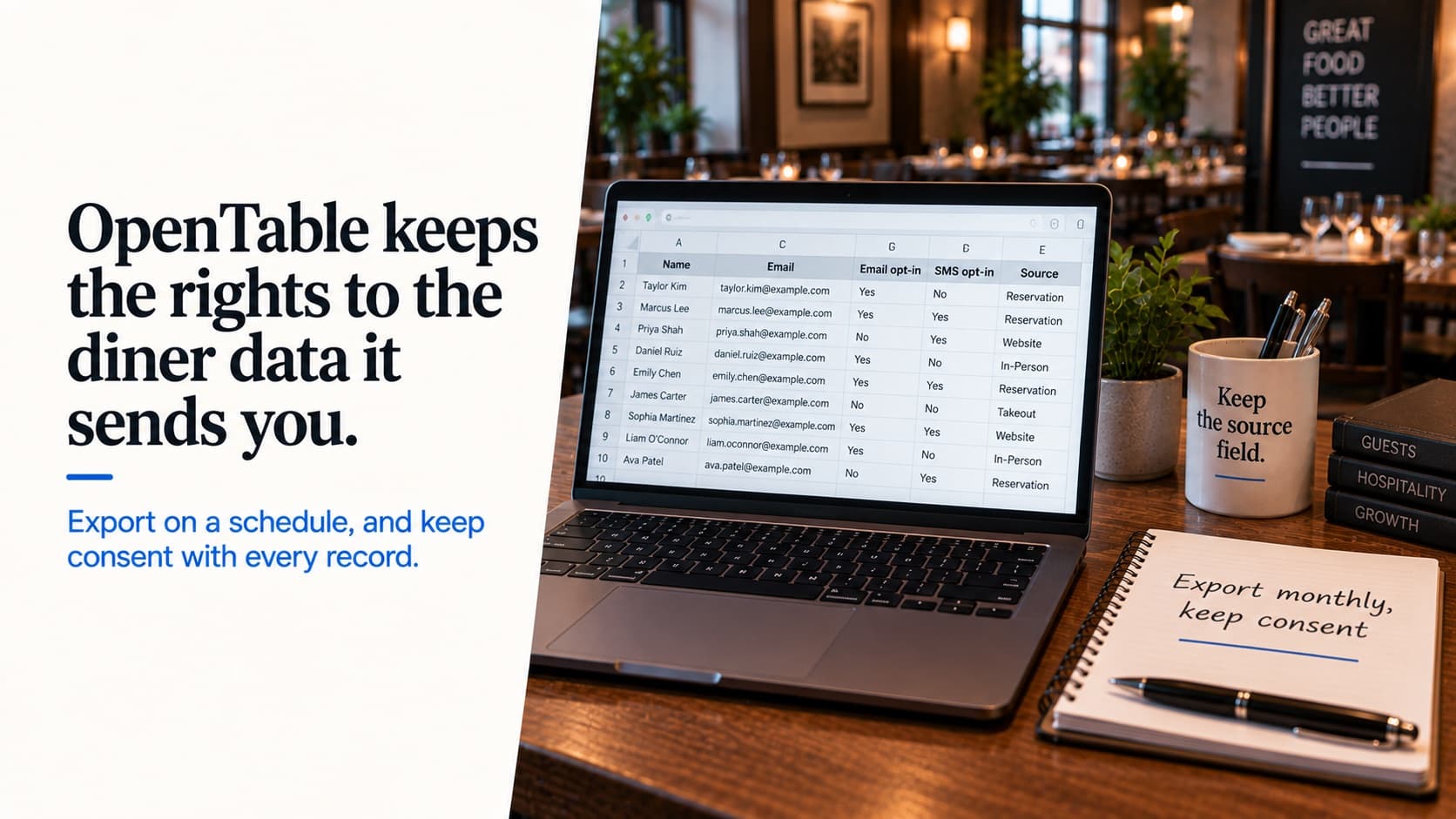
The practical version: only text people who explicitly opted in to texts, keep the consent records, and make leaving easy. A clean list you're allowed to message beats a big list you're not.
Cadence: less than you think
More messages is the fastest way to burn the list. Start conservative — about 1–2 texts a month, capping around 1–2 a week even for engaged segments — and watch your opt-out rate: healthy is under 0.3% per send, and the top reason people leave is simply "too many messages." Let subscribers pick their cadence at signup and send more to the engaged, less to the new. Restraint is what keeps the channel valuable.
Disclosure: I work at Katalyst, and when loyalty, gift cards, and the guest record live in the same system as the POS — optionally feeding a branded app — the list builds itself from transactions and the automations fire on real guest behavior. That's the version I'd sell you. But the discipline is free and vendor-neutral: capture the contact at the moment of service, run the three automations that matter, get consent the right way, and don't over-message. Your guest list is the one marketing asset a delivery app can't rent back to you. Most restaurants let it sit at 15%.
Related Katalyst products
See how Katalyst handles your service style
A 30-minute walkthrough of the platform, tuned to how your restaurant actually runs.