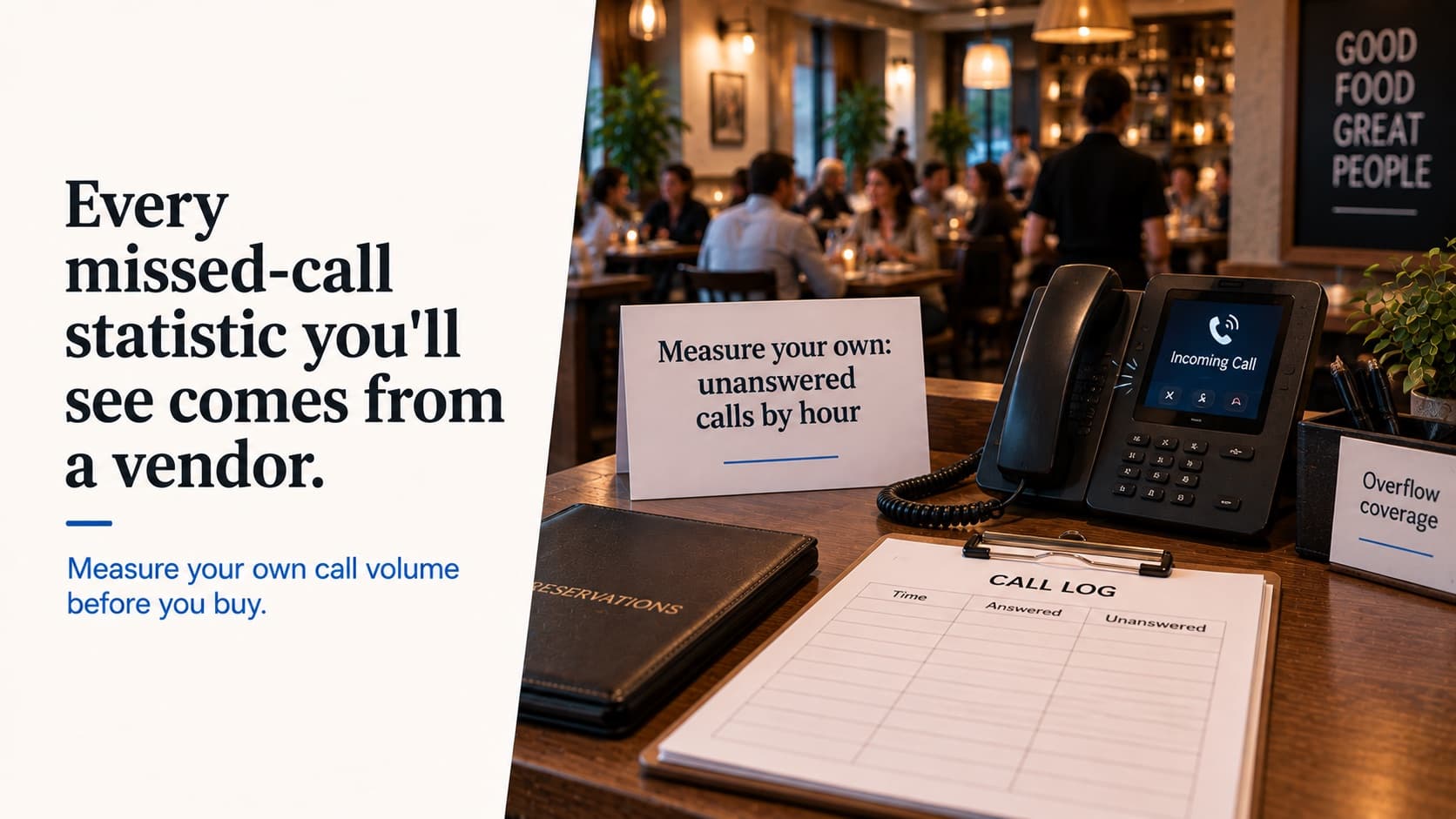
Every missed-call statistic you'll see comes from a vendor
Published prices run from $85 a month to $599 per location, or $1.50 per completed order. A wiretap suit over a Domino's AI phone call survived dismissal.

The pitch for AI phone answering always opens with the same kind of number: restaurants miss a large share of their calls, and each missed call is a lost order. The numbers vary. I found 23%, 36%, 40%, 43%, 58% and 60% during peak hours, all quoted with confidence.
I went looking for where each came from, because the size of that number is the entire business case. Every figure I could trace came from a company that sells AI phone answering. That doesn't make the problem imaginary. Anyone who has stood at a host stand at 7:30 on a Friday knows the phone rings out. It does mean the number to plan around is your own, and you can measure it for free.
Where the numbers come from
| Figure | Source | What's behind it |
|---|---|---|
| 43% of calls unanswered | Attributed to Breez, 2025 | Repeated by several vendors; I couldn't find the original or a method |
| 60% missed at peak | Slang.ai | "Proprietary dataset" of millions of calls; no sample published |
| 23%, 36%, 40% | Hostie | Different figures in different posts, from its own customers |
| 40.1% (quick service) | Revmo AI, August 2026 | 12,091 call recordings; sample stated, customers not described |
| 58% | Hostie with Harris Poll, 2025 | A survey of diners, not measured call data |
The Harris Poll survey is the most rigorous piece here, and what it measured is attitudes. 63% of 2,065 adults said they prefer to phone a restaurant, and 69% said they'd likely give up on one that doesn't answer. That's evidence the phone matters. It isn't evidence of how many calls you miss.
Your phone carrier already knows. Most business phone systems and VoIP providers log every inbound call with its outcome. Pull two weeks, count unanswered calls by hour, and you'll have a better number than any vendor can give you. It'll usually show a sharp spike in two or three windows, which also tells you whether you need an all-day system or overflow coverage for the rush.
What it costs
Three pricing models are published, and they break even at very different volumes:
| Vendor | Plan | Price | What's included |
|---|---|---|---|
| Maple | Voice | $85/mo annual, $150 monthly | Answering; no POS orders |
| Maple | Pro | $220/mo annual, $350 monthly | Orders into Toast, Square, Clover, SkyTab |
| Slang.ai | Core / Premium | From $399 / $599 per location per month | Integrations listed are reservation and CRM tools |
| Kea | Published plans | $450/mo flat, unlimited calls (per its own blog) | Claims 11+ POS integrations |
| Bite Buddy | List rate | $1.50 per completed order | Claims Toast, Square, Clover and others |
Loman, SoundHound, Voiceplug and others quote on request.
The per-order model is the easiest to reason about. At $1.50 an order, a $450 flat plan is cheaper once you pass 300 AI-taken orders a month, about ten a day. Maple Pro's annual price breaks even at roughly 147. A restaurant that takes a handful of phone orders on a weeknight is paying for capacity it doesn't use on a flat plan.
Check what "order" means in each contract, too. A system that answers questions and books reservations but doesn't write tickets into your POS is doing a different job from one that takes a paid order with modifiers. Slang's pricing page, for example, lists reservation and CRM integrations, not POS order-taking.
The human behind the curtain
Two public examples are worth knowing before you sign.
Presto, which sold drive-thru voice AI, disclosed in its own 2023 SEC filings that more than 70% of orders at its advanced pilot sites needed help from off-site human agents. At most of its original sites, all of them did. The SEC charged the company in January 2025 over misleading claims about its AI.
McDonald's ended its drive-thru voice test with IBM in June 2024, after about three years. Taco Bell, running voice AI in more than 500 drive-thrus, told the Wall Street Journal in August 2025 that it was reconsidering keeping humans on the line during busy periods.
None of that means current products don't work. Speech recognition has improved a lot since 2023. It means the right question for a vendor isn't "does it work" but what share of calls get handed to a person, and who is that person. If the answer is your own staff, you know exactly how often your phone will still ring. If it's the vendor's agents somewhere else, you want to know that too.
The legal part nobody mentions in the demo
Recording consent. AI answering records and transcribes calls. In states that require every party's consent to record, including California, Florida, Illinois, Maryland, Massachusetts, New Hampshire, Pennsylvania and Washington, the greeting needs to say so before the caller says anything else.
The vendor as eavesdropper. In Taylor v. ConverseNow, a Domino's customer sued the AI company that took her phone order, which captured her name, address and card number. In August 2025 a federal court in California refused to dismiss her claim under the state's wiretap law. It reasoned that a vendor using call data to improve its own product could be a third party listening in, not just a tool the restaurant uses. The case isn't decided, but the theory survived. Read the data section of any contract: does the vendor use your callers' recordings to train its models?
Disclosing that it's AI. Maine now requires clear notice when an AI chatbot is used in trade, and its definition covers spoken conversations. Utah requires disclosure when a customer asks. The simplest policy is to say so in the greeting everywhere.
Outbound calls are different. The FCC ruled in 2024 that AI-generated voices count as "artificial" under the Telephone Consumer Protection Act. That covers calls you make, so a system that phones guests back needs their prior consent. Answering inbound calls isn't affected.
Allergens
I checked the pages of four vendors for a published statement on how their systems handle allergen questions, or who bears responsibility when they get one wrong. None had one. Allergens appeared only in marketing copy about escalating to staff.
Make that escalation a rule, not a setting you hope is on. Any call that mentions an allergy should go to a person, and the system should say so to the caller. The reason is in the allergen post: the order path is where most allergen failures start.
What I'm not going to give you
A missed-call rate. Every one I found is a vendor's. Measure yours.
An ROI figure. The vendors' ROI claims multiply their own missed-call rate by an assumed order value and an assumed conversion rate. Swap in your own numbers and the answer changes completely.
A recommendation between vendors. The published prices are here. Performance on your menu, with your callers' accents and your modifiers, is something only a trial shows.
What to do
- Pull two weeks of call logs from your phone provider and count unanswered calls by hour.
- Start with overflow, not replacement. Have the system pick up only when the phone rings past three or four times. You'll see real volume without taking calls your staff would have answered.
- Put recording and AI disclosure in the greeting.
- Read the data-use clause. Ask whether recordings train the vendor's models, and whether you can opt out.
- Route every allergy call to a person.
- Ask for the handoff rate in writing, and who the humans are.
- Test the POS integration with your hardest order, not a burger. Modifiers, half-and-half pizzas and substitutions are where tickets come out wrong.
Disclosure: I work at Katalyst. We don't sell AI phone answering, so I have no product in this comparison. We do sell the POS these systems write orders into, which is why the last step is on the list.
Related Katalyst products
Topics
See how Katalyst handles your service style
A 30-minute walkthrough of the platform, tuned to how your restaurant actually runs.