Your photographer's contract sets how many meals you serve
A university caterer adds $1,000 to every wedding for labor alone, and $2 a head across the whole room when one entree choice passes 20%.

A restaurant that has been doing corporate drop-off for a year decides to take weddings. The owner looks at the per-head number a caterer down the road quotes, compares it to their own food cost, and concludes that weddings are the same business with a bigger markup.
They are not the same business. I have sold about 130 weddings a season for nine years, and the gap between those two numbers isn't margin. It's a list of obligations that arrive with the event, most of them written into documents you didn't draft. The best evidence I can show you for that isn't from a caterer at all.
A university charges $1,000 extra, just for weddings
The Wisconsin Union publishes its catering policy. Buried in it is a flat $1,000 "Large Event Special Service Fee" added to every wedding reception, and the document says what it's for: "the increased amounts of labor involved in servicing these events, extra equipment, and earlier room preparation times."
That's a non-commercial institution, with no sales incentive, writing down that a wedding costs more to service than the corporate lunch it catered the same week. If you're pricing your first weddings off your drop-off math, start there.
The headcount is not the guest list
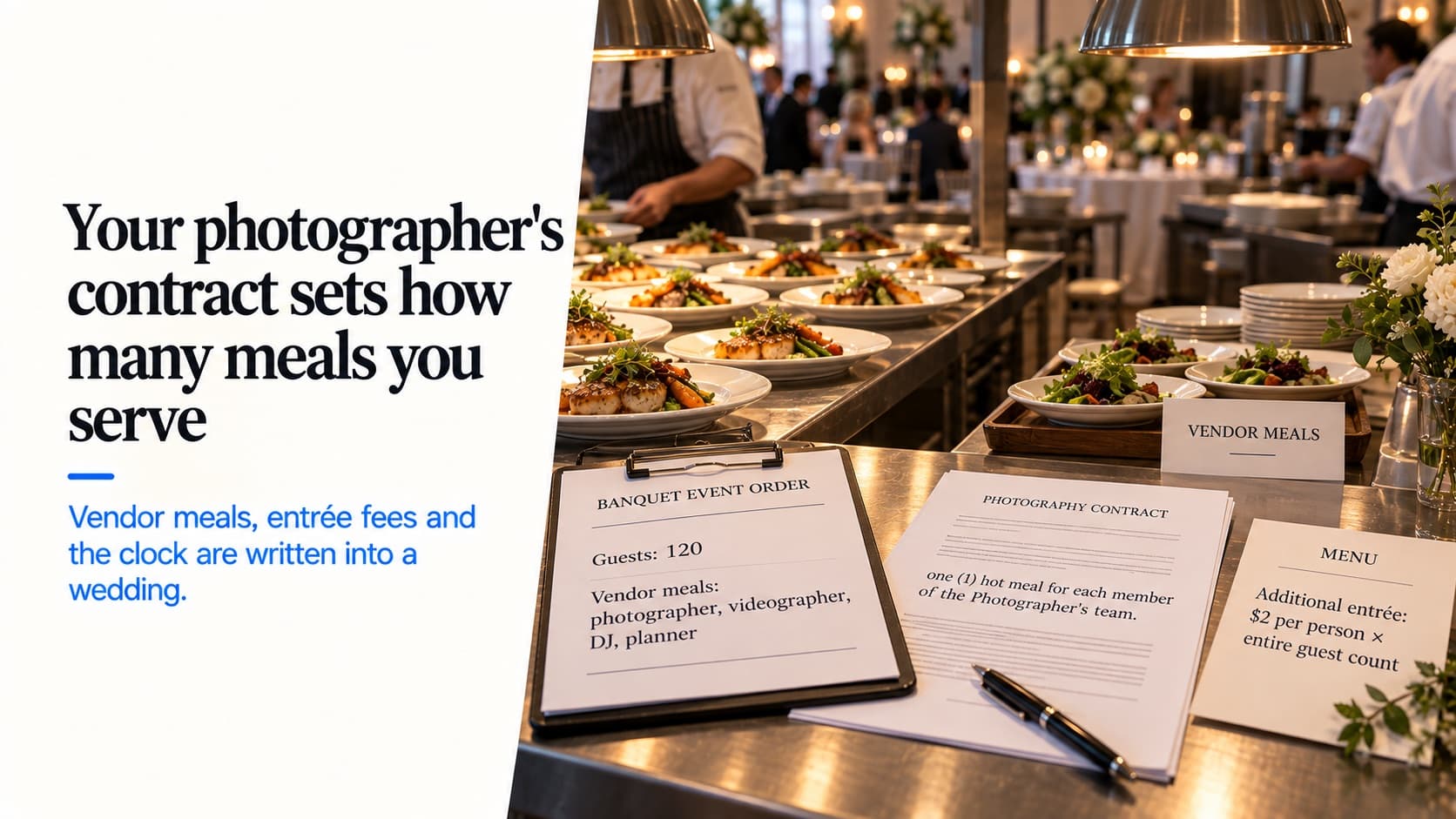
Here's the one that surprises every restaurant new to weddings. The couple tells you 120 guests. You will serve more than 120 meals, and the reason sits in contracts between the couple and their other vendors.
Photographers' contracts routinely require it. One published clause reads: "you agree to provide one (1) hot meal for each member of the Photographer's team present at the Wedding." A stricter version in circulation refuses a reduced plate outright and prices the breach: vendors "are to be fed the same meals as the wedding guests," and "if this provision is not met, you agree to pay $100 per photographer and staff."
So the couple arrives at your tasting already obligated to feed a photographer, a second shooter, a videographer, a DJ, a planner and possibly an assistant. Nobody counted those people when they told you 120.
Caterers handle it two ways, both documented:
- A flat vendor rate. Sardi's Catering charges $25 per vendor, which covers "the main entrée and a beverage."
- A discount off the guest menu. The University of Michigan Golf Course prices vendor meals at "a 10% discounted rate from the menu options chosen by the client."
Either is defensible. What isn't defensible is leaving it out of the proposal, because the couple will assume those plates are free and you will cook them anyway. Put a line on the estimate with a number and a count, even if the count is a guess.
The menu choice that prices the whole room
Entrée choice is where a wedding quietly stops being a fixed per-head number, and the published policies are blunt about it:
- Wisconsin Union: plated meals include two entrée choices plus a child's meal. Each additional selection costs "$2 per person plate fee, multiplied by the entire guest count." And if vegetarians exceed 20% of the count, that extra-entrée fee applies to the full guest count too.
- University of Michigan: "An additional $3.00 per person, per additional entree will be charged when more than 3 entrees are chosen."
Read those carefully. The surcharge isn't per vegetarian. It's per guest, across the room, triggered by a threshold the couple crosses while trying to be accommodating. That is the correct way to price it, because the kitchen cost of a third entrée is a third production line, not thirty extra portions.
If you write nothing else into your first wedding contract, write the number of entrée selections included and the price of another one.
The clock is a contract term
Corporate drop-off ends when the van leaves. A wedding does not, and the real documents handle it with hard stops rather than hourly rates:
- UMich: "All menus are based upon a 90-minute service period. Food items will be removed at the end of the service period."
- Wisconsin Union: 2.5 continuous hours for food service, with extra time available for purchase.
- Wisconsin Union again, on late starts that aren't the caterer's fault: more than 30 minutes late "may result in a surcharge of 5% of the final bill"; more than an hour, 10%.
I looked for a venue contract stating a dollar-per-hour overtime rate and couldn't find one. Every real document I obtained used a percentage surcharge, a hard stop, or per-staff-per-half-hour billing. The popular advice to "charge $500 an hour for overtime" has no contract behind it that I can show you. A surcharge tied to the final bill is easier to enforce and easier to explain at 10pm.
The bar has four models, not three
Consumer guides describe open bar, cash bar and consumption. There's a fourth in the real policies, and it's the one that protects you:
The minimum guarantee. The Wisconsin Union runs bars "on the premise that sales will generate at least $150 per hour per bartender," and if they don't, the client pays the difference. UMich runs the mirror image: a $100 setup fee per bar, waived if sales meet or exceed $350, and a cash bar at $100 for the first hour plus $25 per additional hour, with the hourly fee waived if sales average $100 per hour per bar.
The rest of the UMich bar policy is worth copying as a checklist, because every line is a decision you'd otherwise make at the event: bar service capped at 4 hours, ending one hour before the event and never past midnight; beer, wine and spirits only, no shots or pitchers; a maximum 1½ oz of liquor per mixed drink; no more than two drinks per guest at a time; certified bartenders.
And the constraint that decides whether you're in the bar business at all: licensing is per event, not just per business. Georgia's rule requires a caterer to hold a state retail license, plus a local alcoholic beverage license, plus a local catering event permit, and to notify the Commissioner in writing at least five business days before each catered event. There is no provision in it for an unlicensed caterer to pour the host's own alcohol.
Check your own state, because the models differ. But do check before you quote a bar package, and remember that standard general liability policies exclude alcohol claims, so liquor liability is a separate policy.
The cake fee people call a scam
The cake-cutting fee has a bad reputation, and the contracts show why it survives. 12Eleven Catering charges a flat $100, and itemizes what that includes: "cutting of the wedding cakes (wedding cake and grooms cake)… disposable plates, forks and white beverage napkins." The client supplies wrap for leftovers. UMich charges $2.50 per person and allows outside wedding cake as one of only two exceptions to its no-outside-food rule.
Priced per slice with no explanation, it reads as a toll on a cake you didn't sell. Priced as a flat fee with the plates, forks and napkins listed, it reads as what it is. Same money, entirely different conversation, and I've had both.
Tastings: charge, then credit
Four published policies, one pattern:
| Caterer | Fee | Guests | Credited? |
|---|---|---|---|
| Sardi's | $50, +$25 per extra taster | Max 4 | Only if they book, pay the booking fee and order $1,500+ |
| Green Mangos | $100 (2 people), $150 (4) | Up to 4 | Applied to the final invoice on booking |
| JT's Custom | $150 | Up to 6 | Waived if they book the same day |
| 12Eleven | Free once the date is secured; $50 before | — | — |
Charge for the tasting, credit it on signature, and cap the guest count in writing. Four tasters is plenty; six is a dinner party you're cooking for free.
What I'm not going to give you
A per-head price. The two most-quoted national figures disagree by double, and they measure different things. The Knot's Real Weddings Study puts wedding catering at $80 per person; WeddingWire's cost guide, from the same parent company, reports $40 per person plated and $27 buffet from reviewer-reported spend. One is derived from total food and beverage, the other from a single vendor line. Quote whichever you like, name it, and say what it measures.
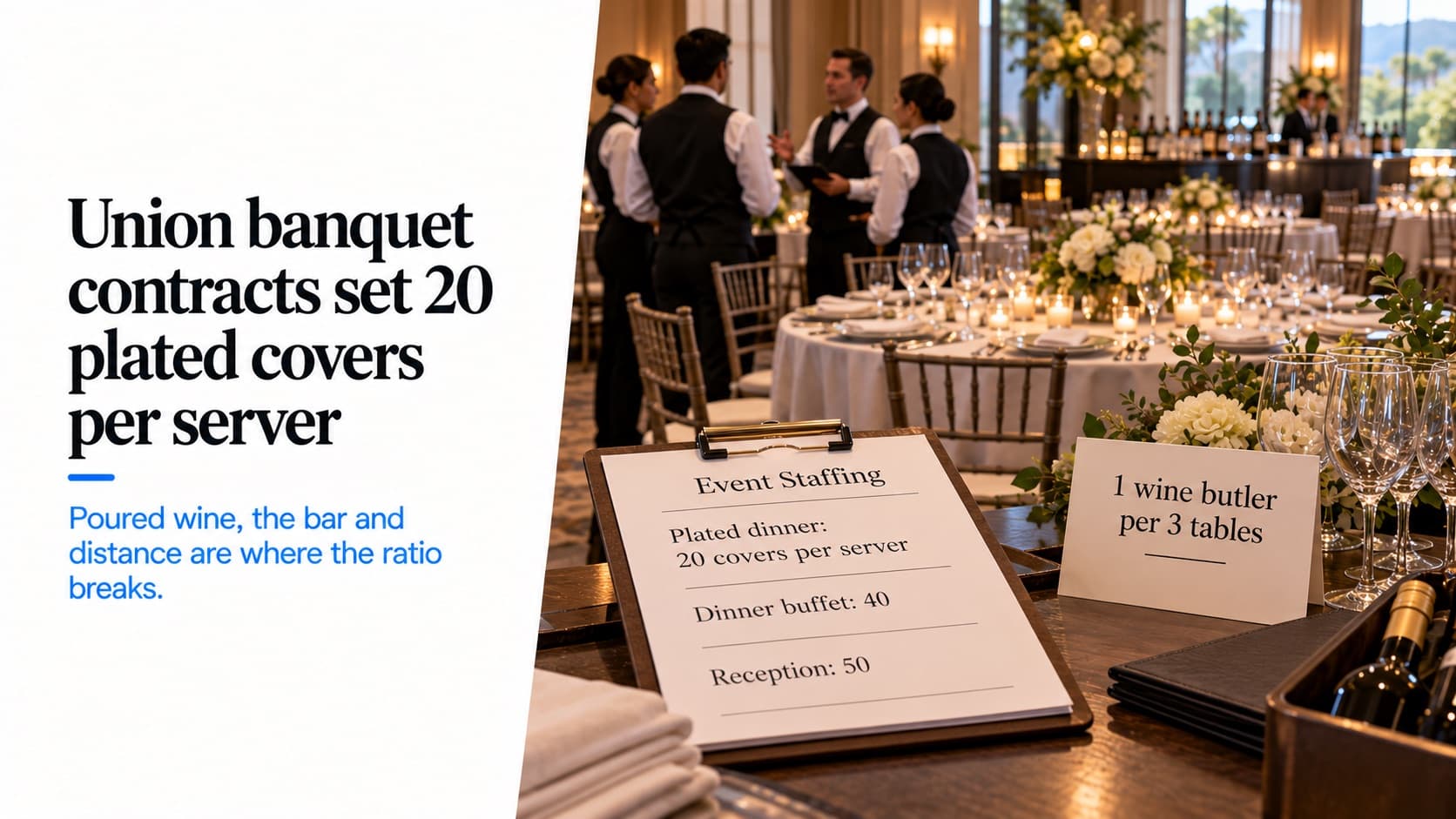
A plated-versus-buffet cost comparison. The staffing ratios that circulate — one server per 8 to 10 guests plated, one attendant per 25 to 40 on a buffet — are consistent across sources and rest on no published study. Family style and stations have no cost documentation at all.
A cake-fee range. Reported figures run from $1.50 per person to $5 or more per slice, and don't reconcile.
What to do before your first wedding
- Add a vendor-meal line to every proposal, with a count and a price. Ask for the other vendors' meal requirements at the tasting.
- State how many entrée selections are included, what another one costs, and that the charge applies per guest.
- Put the service window in the contract and say what happens when the couple starts late.
- Pick a bar model and a minimum, then confirm your state's per-event licensing before quoting anything with alcohol in it.
- Itemize the cake fee. Plates, forks, napkins, labor.
- Charge for tastings and credit them on signature.
Disclosure: I work at Katalyst, which sells catering software, and I spent years running weddings out of a spreadsheet, a proposal tool and a separate deposit tracker that agreed with each other about once a month. Software helps with the counting. It will not write the entrée clause for you, and the entrée clause is where the money is.
Related Katalyst products
Topics
See how Katalyst handles your service style
A 30-minute walkthrough of the platform, tuned to how your restaurant actually runs.