Regulars install your app; that's why app users order more
Even Starbucks takes only 33% of US transactions through mobile order. Apple requires your app under your own $99-a-year developer account.

The most common argument for a restaurant app is a comparison: guests who use your app order more often than guests who don't. One ordering vendor puts it at "around 2x." I believe the number. I don't believe it means what it's used to mean.
Think about who downloads a restaurant's app. Nobody installs an app for a place they've eaten once. The people who install it are the people already ordering every week. Comparing them to everyone else shows you that regulars order more than non-regulars, which you knew. It doesn't show that the app turned anyone into a regular.
That changes the question. An app is rarely how you get regulars. It's a way to serve the regulars you have better, and the decision is whether that's worth what it costs. I made the same point in the loyalty post: enrollment happens at the register, and the app is something regulars graduate into.
What the best case looks like
The chains with the most invested in apps publish their numbers, and they set a ceiling worth knowing:
| Company | Digital measure | Latest figure |
|---|---|---|
| Starbucks | Mobile order and pay, share of US company-operated transactions | 33% (quarter ended June 2026), with 35.8 million active US Rewards members |
| Chipotle | Digital sales, share of food and beverage revenue | 38.3% (quarter ended June 2026) |
| Domino's | Digital channels, share of US retail sales | More than 85% (2025); app and web not split |
Starbucks is the most instructive. It has one of the largest loyalty programs in the world, an app built into daily routines, and a product people buy several times a week. After all of that, two thirds of its US transactions still don't go through mobile order. Chipotle's and Domino's figures include websites and delivery apps, so the share that comes through their own app is smaller than the headline.
An independent restaurant won't get near those numbers, and shouldn't plan to. The realistic goal is your top slice of guests.
What an app does better than a website
Most of what an app does, a good mobile ordering website does too. Menu, cart, payment, pickup time: the web handles all of it, with no install and no app store. Where an app actually wins is narrower:
- Speed on repeat orders. Saved payment and reorder in two taps. Paytronix, an ordering and loyalty vendor, reported median order completion on iOS apps at under four minutes and says apps complete orders about four times faster than the web.
- Push notifications. The one channel you own that doesn't depend on an inbox. Airship's 2025 benchmarks put the median push opt-in at about 49% on iOS and 60% on Android, so plan on reaching roughly half of the people who install.
- Loyalty in their pocket. Points, rewards and a saved card in one place, without searching email for a link.
Where it loses is discovery. Nobody searches an app store for a neighborhood restaurant. Every install starts with someone who already knows you, which is the whole point above.
What Apple and Google require
This part surprises people who buy an app from a platform vendor.
Apple's guideline 4.2.6 says apps built from a commercial template or app generator "will be rejected unless they are submitted directly by the provider of the app's content." The vendor can build it, but the app has to be published under your own Apple developer account, in your business's name. In practice that means:
- The Apple Developer Program at $99 a year, paid by you.
- A D-U-N-S number for your business, which is free in most places but takes time to obtain.
- The account in your name, which is useful: if you change vendors, the app listing and its reviews stay with you.
Google Play charges a one-time $25. One trap: personal developer accounts created after November 2023 must run a closed test with at least 12 testers for 14 days before publishing. Register the account as an organization.
No store commission on food. Apple's rules require apps selling physical goods consumed outside the app to use ordinary payment methods rather than in-app purchase. Orders don't pay Apple's 15–30% cut; card processing is the only fee.
When it pays off
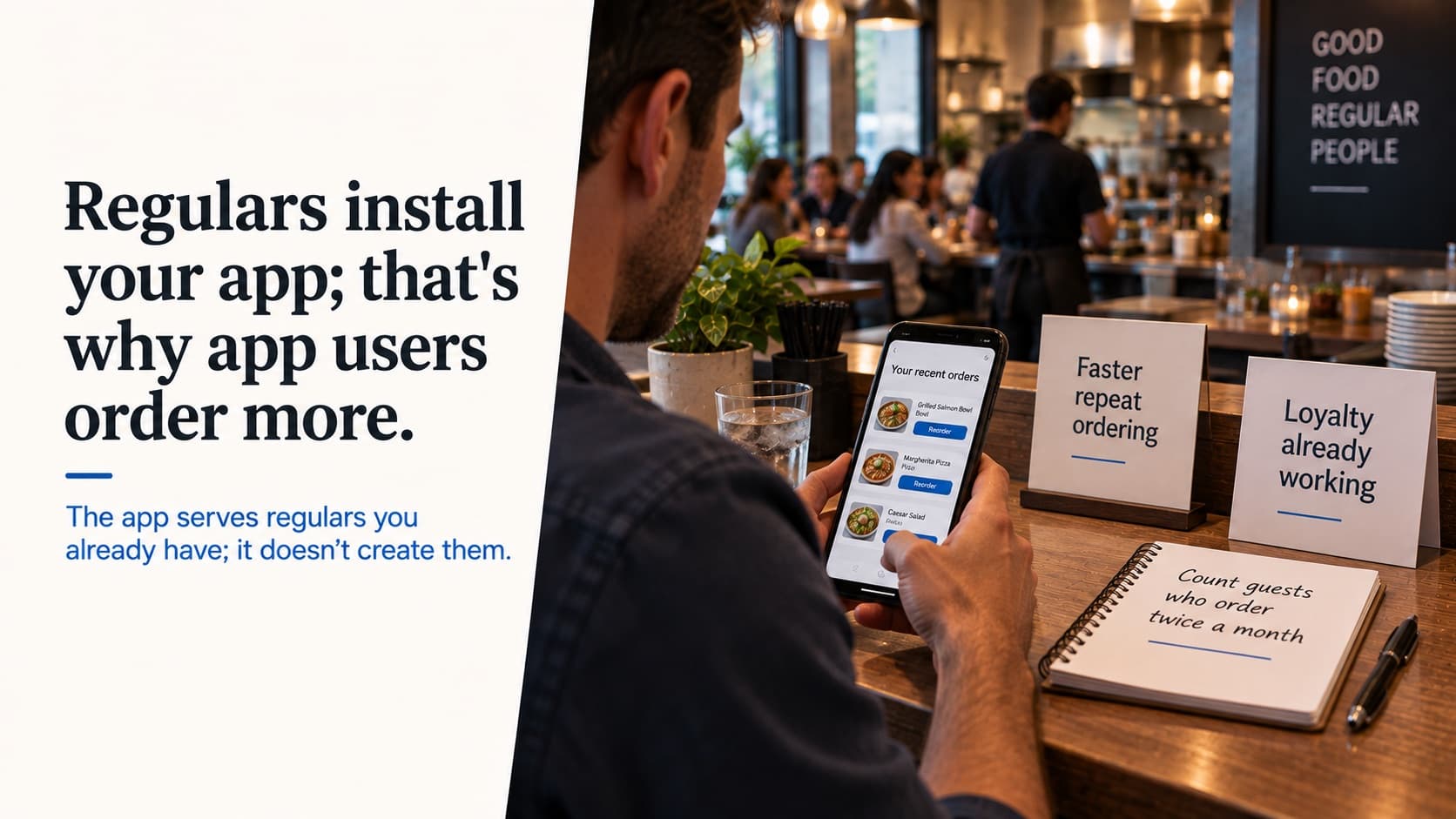
Count the guests who already order from you at least twice a month. That's your app's realistic audience. The rest of the decision follows from that number:
- It usually pays for multi-location groups, high-frequency concepts like coffee, lunch counters and pizza, and restaurants with a working loyalty program whose members already order often.
- It usually doesn't for tourist-heavy locations, occasional destination dining, and anywhere most guests visit a few times a year. Mobile web ordering and a text-based loyalty program will do the job at lower cost.
The honest test is whether you'd notice if your top hundred guests could reorder in ten seconds instead of two minutes, and get a push on a slow Tuesday. If yes, the app is serving customers you already have and the math can work. If you're counting on it to find new ones, it won't.
What I'm not going to give you
An app-versus-web order split for independent restaurants. I looked for independent data and didn't find any. The figures that circulate come from vendors describing their own customers.
A retention figure for restaurant apps. Numbers are quoted, but I couldn't trace one to a primary source I'd stand behind.
The "2x" as a sales projection. See the top of this post.
What to do
- Count your frequent guests. Anyone ordering twice a month or more, from your POS or loyalty data. That's the audience.
- Get loyalty and web ordering working first. An app built on top of a loyalty program nobody joined has nothing to offer.
- Open the developer accounts in your business's name before a vendor starts building. Apple needs a D-U-N-S number; Google needs an organization account to skip the tester requirement.
- Ask who handles OS updates. Apple and Google ship new versions every year, and an app nobody maintains starts breaking.
- Plan one reason to open it that the website doesn't offer: a reward, a reorder button, an app-only item. Without one, regulars install it once and forget it.
- Write your push plan before launch. About half of installers will allow notifications. Decide what's worth interrupting them for.
Disclosure: I work at Katalyst, which sells a branded app built from the POS, so I benefit when restaurants decide they need one. I'd still rather you started from the count in step one. A restaurant with two hundred frequent guests will get real use out of an app. One with twenty won't, however good the app is.
Related Katalyst products
See how Katalyst handles your service style
A 30-minute walkthrough of the platform, tuned to how your restaurant actually runs.